
There is no laboratory in a furniture shop. You have your hands, your nose, your eyes and about four minutes before the salesperson starts hovering. That is usually enough.
Teak is the most copied timber in Southeast Asia, not because forgery is sophisticated but because the word is unregulated. Anybody can print “teak” on a swing tag. What follows is the set of checks we use when timber arrives at our workshop, reduced to what you can do in a showroom.
Seven tests you can do in person
1. Smell it
Freshly cut or sanded teak has a distinctive scent: oily, faintly leathery, some say like old shoe polish. It comes from the oils in the heartwood. Ask for an offcut from the batch, or find an unfinished underside and rub it hard to warm it. A sealed surface tells you nothing, which is exactly why cheap pieces are heavily sealed.
2. Feel it
Unfinished teak feels slightly waxy, never chalky or dry. That is the oil again. Run the back of your fingers over a raw area. Dry, thirsty timber under a shiny coat is usually something else wearing teak-coloured stain.
3. Look at grain and colour consistency
Teak is generally straight grained with a moderately coarse, even texture, in a golden to mid brown. What you want is believable variation: grain that runs continuously across a surface and changes character at the joints between boards. A pattern that repeats exactly every 30 or 60 cm is printed or veneered. Colour that is perfectly uniform across a two-metre top means heavy staining, or a photographic film.
4. Check the end grain and the edges
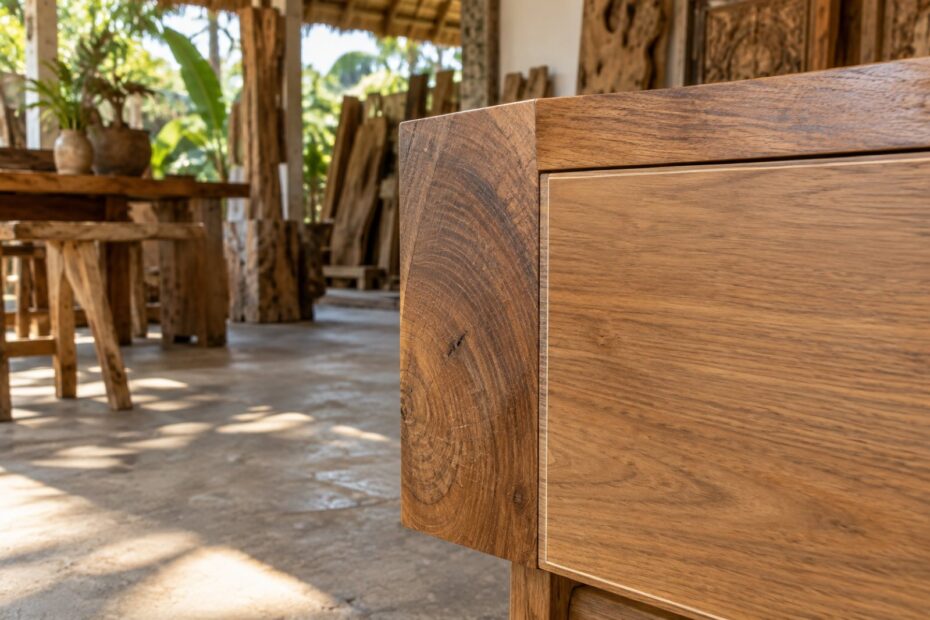
The single most useful test. On a solid board the grain on the top surface continues around and down the edge. Squat and look at the corner of the table. If the top pattern stops dead at a hairline and a different one starts, that is veneer with edge banding.
On the end grain, teak is ring-porous: visible pores in the earlywood and clear growth ring boundaries. A uniform, spongy, biscuit-coloured core is MDF. A layered, striped core is plywood. Thin timber strips glued edge to edge under a skin is blockboard.
5. Weigh it
Teak is moderately dense, heavier than mahogany, lighter than ironwood. Lift a corner. You are testing for a wrong answer, not a number: suspiciously light suggests a hollow core or a light substitute, unusually heavy suggests a different species or a board still full of water. Weight never proves teak on its own, since several substitutes weigh much the same.
6. The water bead test, with a caveat
Drip a little water on an unfinished area. On oil-rich teak it tends to bead and sit rather than soaking straight in and darkening.
The caveat matters: this works only on raw, unsealed timber. Any finish makes almost any wood bead, so a positive result on a finished surface proves nothing. Treat it as the weakest of the seven.
7. Look underneath and inside
Cheap construction is never hidden on top. Turn a chair over. Open a drawer and look at the sides, back and bottom. Look behind a wardrobe.
You are checking three things: whether the hidden timber matches the visible timber, whether the drawer box is solid or thin board with a stapled bottom, and how the corners are joined. A workshop that nails and fills always shows itself here.
Teak grades A, B and C, explained honestly
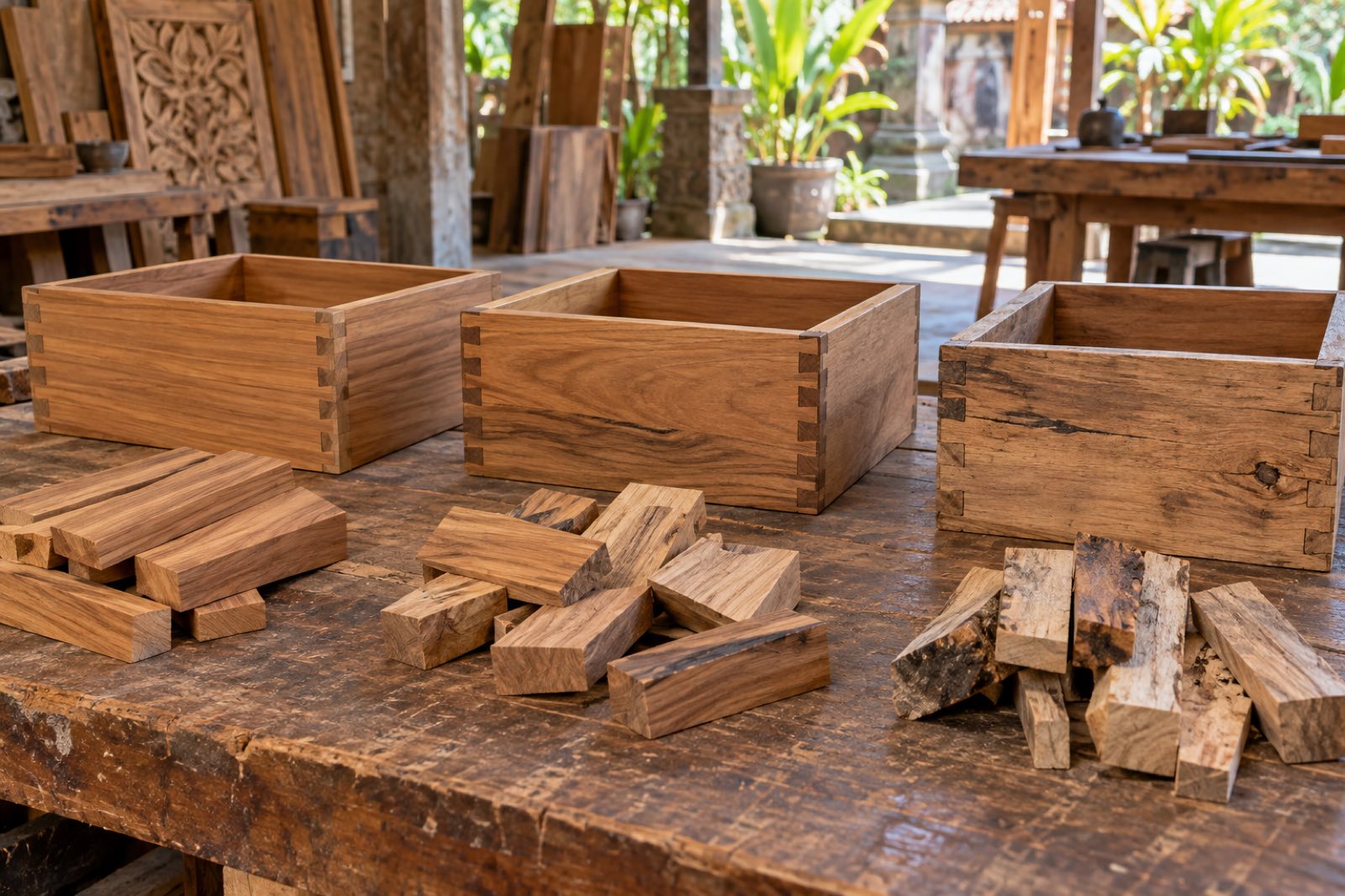
Grading in the teak trade is a commercial convention, not a legal standard. It varies between mills, so ask what a seller means by it. Broadly:
| Grade | What it is | Where it belongs |
|---|---|---|
| A | Heartwood only. Even golden brown, tight straight grain, few or no knots, no sapwood. Highest yield loss, highest price. | Fine indoor pieces where uniformity is the point. |
| B | Predominantly heartwood. Some colour variation, small sound knots, occasional narrow sapwood at an edge. Structurally the same timber. | Most furniture. Dining tables, casegoods, outdoor pieces with the sapwood cut out. |
| C | Wide colour variation, larger and more frequent knots, more sapwood, possible minor checks. | Rustic and painted work, utility and service pieces, character-led designs. |
Two things people get wrong about this.
Grade A is not always the right choice. Grade describes appearance and yield, not strength. On a large dining top, grade B with its colour variation running across the surface looks like wood; the same top in uniform grade A can read as flat, almost synthetic. You pay a real premium for that uniformity, often for a look you did not want. For most furniture, grade B is the sensible choice, and we say so regularly.
Sapwood is the exception that matters. The pale outer sapwood lacks the oils that make teak durable. For anything outdoors or in a bathroom, specify heartwood, whatever letter is on the invoice.
For the wider background see All About Teak Wood, and 8 Types of Wood and Their Characteristics for how teak compares to the other timbers you will meet in Bali.
The four things commonly sold as teak
Teak veneer over blockboard or MDF
The most common substitution, and not automatically dishonest. A well-made veneered panel is a legitimate product, particularly on wide flat surfaces that would otherwise move.
The problem is silence. Sold as solid teak, the difference shows up the first time the top is deeply scratched or left under a wet glass: a veneer takes one light refinish at most, then it is gone.
How to spot it: the edge test above, a hollow sound when you tap the middle of a large top against near the edge, exposed core at any drilled hole or hardware cut-out, and a repeating grain pattern.
“Burmese teak”
Burmese teak is the same species, Tectona grandis, from Myanmar, historically old growth and genuinely excellent timber. The phrase is also used loosely to mean “the best”, and much of what carries the label in regional showrooms is ordinary plantation teak.
There is a compliance point too. As of September 2026, Myanmar timber has been under sanctions and import restrictions in the EU, the UK and the United States for several years, so anything sold as Burmese teak should come with paperwork rather than a story; verify the position for your own market before importing. Indonesian plantation teak, largely managed by Perhutani on Java, is legal, traceable and perfectly good furniture timber.
Iroko and afrormosia, sold as “African teak”
Iroko (Milicia excelsa) is the usual stand-in: durable and a decent timber in its own right, but coarser, more open-pored, more interlocked in grain, and without the oily leathery smell. It starts yellower and darkens unevenly.
Afrormosia (Pericopsis elata) looks closer to teak and is finer textured. It is also listed on CITES Appendix II, so legal trade requires permits. Documentation is not optional.
How to spot both: smell and end grain. Neither smells like teak, and iroko’s pores are noticeably larger and more scattered.
Stained mahogany or acacia
The budget substitution, and common in Bali. Mahogany is lighter, with a pinkish-red base tone that a teak-coloured stain sits on top of. Acacia has dramatic dark streaking and a much wilder figure, and is frequently marketed as “golden teak”. Our Color Chart & Material Knowledge page shows how far a stain can shift a timber’s apparent colour.
How to spot both: find an unfinished surface. Inside a drawer, the underside of a seat rail, the back of a cabinet. Stain rarely reaches there, and the true colour is obvious the moment you look.
What to ask the seller, and what to ask for in writing
Ask these five questions out loud:
- Is this heartwood, or does it include sapwood?
- Is the top solid through, or veneered? And the doors and drawer fronts?
- What board thickness, and what moisture content was it dried to?
- Is the frame the same species as the surface?
- Can I see an unfinished offcut from this batch?
Then ask for these in writing:
- The botanical name, Tectona grandis, not just the word “teak”.
- Solid or veneered, stated component by component.
- Country and region of origin.
- Board thickness and target moisture content.
- For export orders, the V-Legal document issued under Indonesia’s SVLK timber legality system. Exports require it, so a supplier who cannot explain it is not an exporter.
A seller who answers all of that without hesitating is one you can buy from.
Come and handle it yourself
Photographs cannot pass the smell test. If you are in Bali, make an appointment and come to our workshop and gallery in Celuk, Sukawati. We will hand you offcuts of grade A, B and C, an unfinished board and a finished one, and you can run every test in this article yourself.
WhatsApp +62 812-3842-178 to arrange a visit, or browse what is on the floor in our shop.