
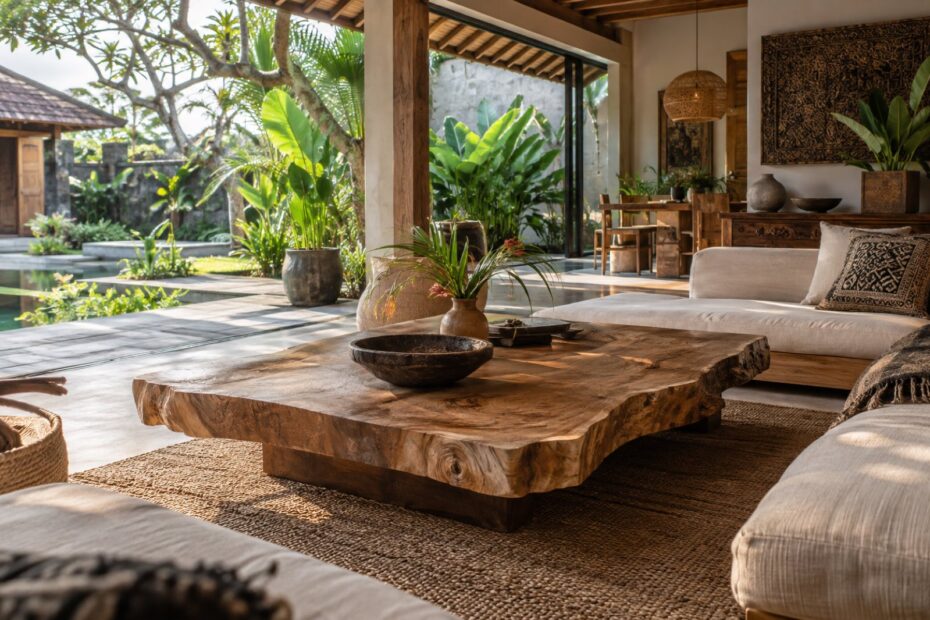
You can recognise the resort version of Bali style from the doorway. A rattan pendant the size of a wheelbarrow. A Buddha head on a plinth, which is an odd object on a Hindu island. Frangipani floating in a stone bowl, refreshed every morning by someone on the payroll. And every timber surface in the room the same mid-brown, because it all arrived from one catalogue in one season.
It photographs well. It is also the reason people ask us for the Bali look and then apologise for asking. The style has been copied so many times that the copies have become the reference.
The original is quieter, and much older. It comes from how buildings here were made before air conditioning: deep shade, cross-ventilation, a small number of materials used honestly, and rooms that open onto something green. Get those right and the decorating takes care of itself. Get them wrong and no amount of rattan will rescue the room.
The clichés worth dropping first
Not because they are Balinese. Mostly because they are not.
- Everything in one mid-brown. Floor, table, sideboard and bed stained to the same tone. Real rooms here have range: pale coconut, honey teak, near-black ironwood, grey stone.
- Rattan on every surface. Rattan is excellent in small doses. Used for the pendant, the chairs, the headboard, the mirror and the laundry basket at once, it stops being texture and becomes a theme.
- Devotional objects as ornaments. If you want something with meaning in the room, learn what it is and place it properly. Otherwise leave it in the shop.
- The indoor water feature. A trickling bowl in a room with no airflow adds humidity and very little else.
- Six matching printed cushions. Bought as a set, matched to the sofa, and dead on arrival.
Drop those and you have room for the things that make the look work.
Air and shade come before decoration
Tropical modern interior design is a climate response before it is a style. The features people love about it, the deep overhangs, the tall ceilings, the wide openings, the pale walls, all exist because they make a hot, humid room comfortable without machinery.
So begin there. Where does the cross-breeze enter and leave? Which wall gets the hard afternoon sun, and what is shading it? Is the ceiling high enough for hot air to sit above your head? A room with good shade, a working breeze and one generous opening onto greenery reads as tropical when it is completely empty. That is the test. If the empty room feels wrong, furniture will not fix it.
One hero wood, one stone, one textile family
The single most useful rule we give clients is a restraint rule. Choose one hero wood, one stone, and one family of textiles. Everything else in the room supports those three.
The hero wood is the character of the room. It appears in the pieces people touch and look at: the dining table, the bed, the main cabinet. A second, quieter wood can carry the background joinery, but it should recede rather than compete.
The stone is your cool, matte counterweight. In Bali that is usually andesite, paras limestone, terrazzo or river stone. It stops a timber-heavy room from feeling like a sauna.
The textile family is the softness and, usually, the only real colour. Handwoven cotton, linen, raw silk, an ikat panel. Keep them related in weight and finish rather than matching in pattern.
Choosing your hero wood
Three species do most of the work here, and they behave very differently.
Teak is the safe, warm, formal choice. High natural oil and silica, class 1 durability, very stable, and it takes a low sheen beautifully. Use it when you want the room to feel calm and slightly traditional. Our full breakdown is in All About Teak Wood.
Suar, usually as a wide single slab, is the dramatic choice. The sapwood and heartwood contrast gives you a pale rim around a dark centre, and one suar table can carry an entire room. Use it when you want a single strong gesture. See All About Suar Wood.
Ironwood is the heavy, dark, outdoor-tough choice. It is dense, extremely durable, and it silvers to a beautiful grey outside. Use it for terraces, benches, decking and pieces that will get wet. More detail in All About Ironwood.
Pick one. Two hero woods in one room usually reads as indecision.
Let texture do what colour does elsewhere
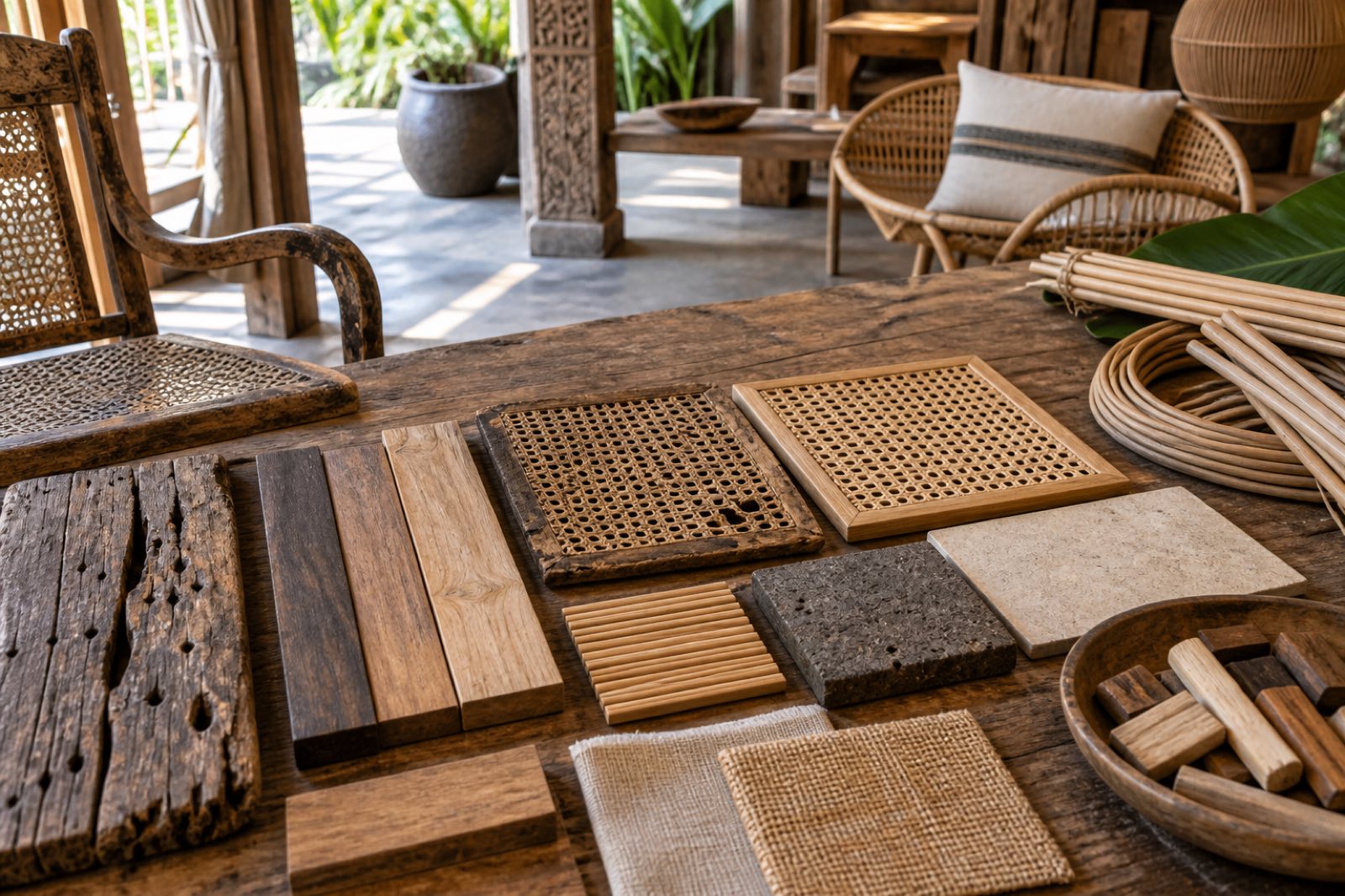
In a cold-climate interior, colour carries the mood. In a tropical one, light is already doing that, and strong colour on a wall goes flat and hot under it. So the interest has to come from surface.
That means hand-trowelled plaster rather than flat paint. Brushed or lightly sanded timber rather than mirror gloss. Loose-weave curtains that move. A stone floor with variation in it. A rough basket beside a smooth ceramic. Stand in the room and count the surfaces you would want to touch. Fewer than five and it feels bare. More than a dozen and it feels busy.
Our Colour Chart & Material Knowledge page shows how one species reads across different finishes, usually a more useful decision than changing species.
Get the look: a working material palette
| Layer | Pick one | Why it works | Common mistake |
|---|---|---|---|
| Hero wood | Teak, suar slab or ironwood | Sets the character; appears in 2–3 key pieces | Three species competing in one room |
| Support wood | Mahogany, acacia, coconut or camelina, quieter finish | Background joinery that recedes | Matching it exactly to the hero wood |
| Stone | Andesite, paras, terrazzo, river stone | Cool matte counterweight to all that timber | Polished stone that bounces glare |
| Wall | Lime or hand-trowelled plaster, off-white to sand | Texture under strong tropical light | Flat brilliant white, or a feature colour |
| Textile | Handwoven cotton, linen, one ikat piece | Softness and the only real colour source | Six matching printed cushions |
| Metal | Blackened steel or aged brass, small quantities | Sharpens the softness | Chrome and high-gloss finishes |
| Green | Two or three large plants, not fifteen small ones | Reads as landscape, not as a shelf display | Small pots on every surface |
Thresholds, low furniture and empty space
Three habits separate a real tropical room from a themed one.
Treat the threshold as a room. The step between inside and out should be a place, not a line: a covered terrace, a wide sill, a bench in the shade. Run the same floor material through the opening if you can. That detail does more for indoor-outdoor flow than any amount of glass.
Keep furniture low and horizontal. Low sofas, low tables, long sideboards, beds without towering headboards. It keeps the air above you free and it makes the ceiling feel higher.
Leave the negative space alone. The hardest instruction to follow. A tropical room needs floor you can see and walls with nothing on them, because that is where the light and the shadow land. If you fill every corner you have built a showroom.
Mixing old and new, and choosing one or two local things
A room built entirely from new pieces has no depth, however good the pieces are. One older object fixes it: a weathered carved panel, an antique cupboard, a primitive stool, a piece of a village house. Set it against something plain and modern so the contrast is deliberate.
The same logic applies to local character. One good Sumba ikat hanging on a bare wall says more than twenty souvenirs. Choose one or two things you can actually explain to a guest, and let them have space around them. You can see how we handle that balance in our villa and interior projects.
Does it work outside the tropics?
Yes, provided you translate the principles rather than copy the props. A London flat has no cross-breeze to design around, so the equivalent moves are light, sightlines and restraint: one hero wood, plaster instead of flat paint, low horizontal furniture, warm off-whites, generous negative space, and one honest handmade object with room around it. In Sydney or Los Angeles you can also keep the threshold idea, because the outdoor room still works.
What does not travel is the moisture. Furniture acclimatised in Bali is far wetter than furniture living in a heated European flat, and that mismatch, not the shipping, is the usual cause of cracking after import. If a piece is going somewhere dry and heated, say so before it is built.
If you are working on a house or a villa and want the principles rather than the props, send us your plans or even a rough sketch. We will tell you which pieces are worth making in solid wood and which are not. We are a workshop in Celuk, Sukawati, open by appointment, on WhatsApp at +62 812-3842-178.