
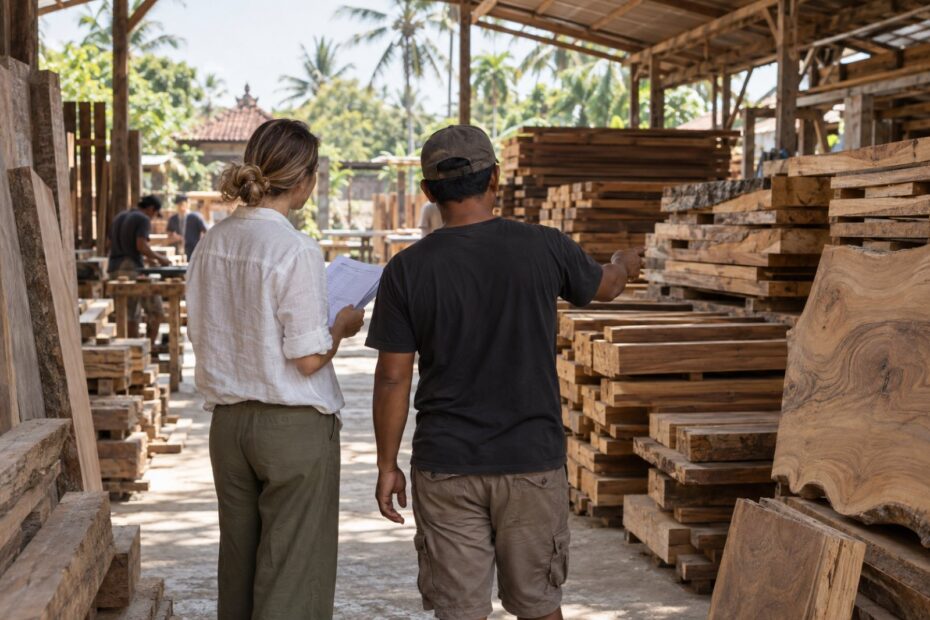
Sooner or later every buyer coming to Bali asks the same thing: should I deal with a workshop directly, or use an agent?
There is a lot of confident advice online and most of it is written by whichever party benefits. Agents say factories cannot be trusted. Factories say agents are a tax on your margin. Both are sometimes right. Having sat on the manufacturing side since 1997 and also acted as a buying and sourcing agent, here is the version we would give a friend.
There are three models, not two, and the third is the one most buyers end up in.
Model one: buying direct from a single workshop
You find a maker whose work you like and buy from them.
What it costs. No third-party commission. You pay the maker’s price, usually the lowest number available for the goods they actually make. You pay instead in your own time: sourcing, specifying, chasing, and noticing when something is wrong.
Who carries the QC risk. You do, unless you agree otherwise in writing. Good workshops have internal quality control and send photographs before packing. That is not the same as an independent inspection.
Who solves problems. The maker is both problem and solution, with no buffer. For a straightforward order with a workshop you trust, that directness is an advantage. When things go badly, it is not.
How much of the container you can fill. Only with what they make, and this is the real constraint. If a workshop is a dining and case goods specialist and you also want lighting, ceramics, rattan and cushions, you are either shipping a partly empty container or running a second supplier.
When something arrives damaged. One counterparty, one claim, usually resolved by replacement on your next container. Simple, provided they want your repeat business.
Model two: an independent sourcing agent
An agent buys on your behalf from many suppliers and consolidates the shipment.
What it costs. Commissions across the Indonesian trade are commonly quoted between 5% and 15% of order value, sometimes as a flat project fee. The number matters less than whether you can see it. More on that below.
Who carries the QC risk. The agent inspects, and a good one inspects hard, because their reputation is the entire product. Ask who physically employs the inspector.
Who solves problems. This is what you are actually buying. When a supplier in Jepara is three weeks late and your vessel is booked, somebody has to drive there and stand in the yard. A capable agent does that, and it is worth real money.
How much of the container you can fill. Everything. Furniture, decor, textiles, ceramics, lighting, across many makers and several islands. For a diverse range this is decisive.
When something arrives damaged. The agent claims against the supplier on your behalf, though in practice responsibility can diffuse. Agree in writing who bears the cost of a replacement and who pays its freight.
Model three: a maker who also consolidates
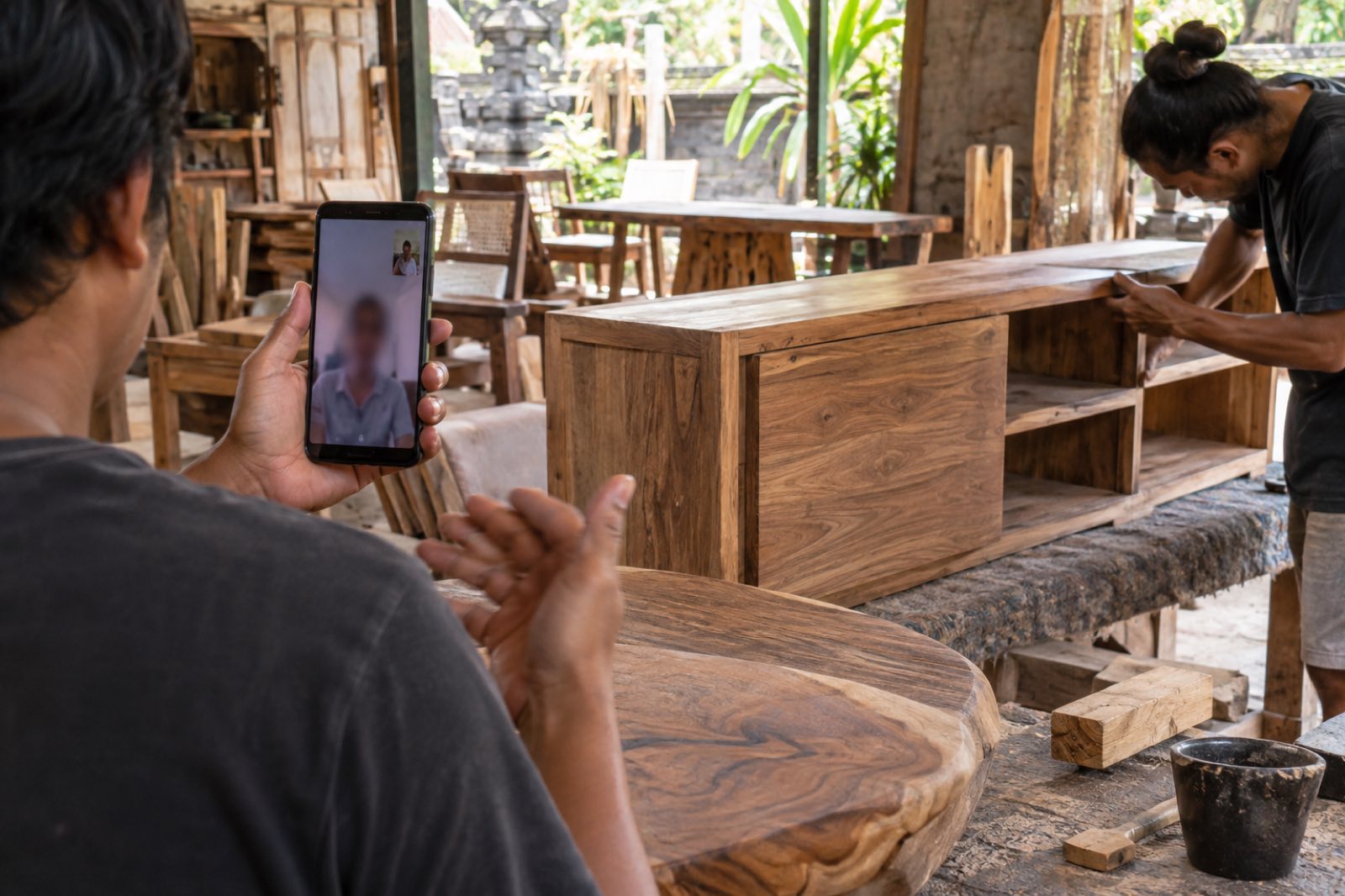
The workshop builds the core of your order and sources the rest from makers it already works with, then packs and ships everything from its own yard. This is the model we operate, and it is why we describe ourselves as a buying and sourcing agent as well as a manufacturer.
What it costs. Their own production at maker’s price, plus a margin or a stated fee on sourced items. Ask which it is, and ask before you order.
Who carries the QC risk. Shared, and importantly, sourced goods land in a yard the consolidator controls, where they are unwrapped, inspected and rewrapped. Faults are caught in Bali rather than in your warehouse.
Who solves problems. They do, because they own the loading date. A maker with a container booked has a strong incentive to chase a late subcontractor.
How much of the container you can fill. Their production forms the core, sourced items fill the gaps and the categories they do not make.
When something arrives damaged. One counterparty for the whole container, even for items they did not build. For most buyers this is the strongest single argument for the model.
Comparison at a glance
| Direct from one workshop | Independent sourcing agent | Maker who consolidates | |
|---|---|---|---|
| Typical cost structure | Maker’s price, no commission | Commission or project fee on top | Maker’s price plus margin or fee on sourced items |
| Product breadth | Only what they make | Very broad, many categories | Core range plus sourced categories |
| QC responsibility | Yours, plus internal QC | Agent’s; check who pays the inspector | Consolidator’s, in their own yard |
| Who chases a late supplier | You | Agent | Consolidator, who owns the loading date |
| Filling a full container | Hardest | Easiest | Easy if your range fits their core |
| Damage claims | One counterparty | Can diffuse between agent and supplier | One counterparty for the whole load |
| Best for | Single-category, repeat orders | Very diverse ranges, many categories | Furniture-led ranges with some decor |
When an independent agent is genuinely the better choice
We would rather say this plainly. Use an independent agent when your range is genuinely diverse and mostly outside one maker’s competence: eight or more categories, a lot of non-furniture, ceramics, glassware, candles, basketry, garments. Use one when you are buying across Java, Bali and Lombok and no single workshop’s yard is a natural hub. Use one when you are a department store or online range buyer whose job is breadth rather than depth.
Conversely, if furniture is the backbone of your order and decor is the trim, a maker who consolidates will usually cost you less and leave you with fewer people to chase.
How to vet whoever you choose
The model matters less than the diligence. Do these five things regardless.
- Visit, or take a live video walkthrough. Not an edited showreel. Ask to see the drying yard and kiln, the machine room, the finishing area and, if possible, a container being loaded. Point the camera where you want it, not where they planned.
- Ask for references from importers in your own market. Same continent, same climate, same customs regime. Then call them and ask what went wrong and how it was handled.
- Place a sample order before a container. Two or three pieces, air freight or LCL, in the finishes you intend to buy. It costs little and tells you more than a year of emails.
- Agree payment terms that protect you. A deposit against production with the balance due on presentation of shipping documents is normal in this trade. Paying 100% before loading is not. Ask what the deposit funds, and discuss a letter of credit for larger orders.
- Check the documentation capability. Ask about SVLK, V-Legal and, if you are EU-bound, EUDR data. A supplier who cannot answer clearly has not exported much.
The risks nobody warns you about
Commission hidden in the unit price. Some agents take a fee from you and a second commission from the supplier. Ask directly: do you receive anything from the supplier side? Then ask to see the supplier’s own invoice, or agree a transparent stated fee. An agent who declines both is telling you something.
Your order quietly subcontracted. A workshop takes an order beyond its capacity and puts half of it out to village workshops with different drying, finishing and tolerances. Subcontracting is normal and often fine. Not disclosing it is not. Ask which line items are made in-house and which are not, in writing.
QC performed by the person the supplier pays. If your inspector’s income depends on the factory, you do not have an inspector, you have a photographer. Either use a genuinely independent inspection for large orders or accept internal QC for what it is and price the risk accordingly.
Moisture content nobody checked. The most expensive failure in this trade is invisible at loading. Furniture dried for tropical Bali and shipped into a heated European home will move and can crack. Put a target moisture content on the purchase order and ask for meter readings with photographs before packing.
Talk to us before you decide
Tell us what your range looks like and we will say honestly whether it suits us or whether a specialist agent would serve you better. You can see the work we build in our projects and read about our services, including sourcing and consolidation. Message us on WhatsApp at +62 812-3842-178, or arrange a live video walkthrough of the workshop in Celuk. We reply within 48 hours.