If you import furniture into the European Union, the United Kingdom, the United States or Australia, sooner or later somebody will ask you to prove where the wood came from. A customs broker, a compliance officer, a hotel group’s procurement team, or a private client who read something about deforestation. “It came from a good workshop in Bali” will not survive that conversation.
The good news is that Indonesia is one of the better documented timber origins in the world, and has been for a decade. The paperwork exists; you need to know what to ask for. Everything below is accurate as of September 2026, and because the European rules have already been postponed twice, verify the current position with your own customs broker before you ship.
SVLK: Indonesia’s timber legality system
SVLK stands for Sistem Verifikasi Legalitas Kayu, the Indonesian timber legality assurance system. It is mandatory, not voluntary, and applies along the chain: forest concessions, sawmills, workshops and exporters are all audited by accredited independent certification bodies.
Indonesia built it for a commercial reason. In the 2000s Indonesian timber carried a reputation problem that was costing exporters business in Europe. Rather than argue, government, industry and civil society built a national verification system and wrote it into law. It is imperfect, as national systems are, but it produces a documented chain from forest to container, and the export licence is only issued when that chain checks out.
For you as a buyer the point is simple: any workshop exporting timber furniture from Indonesia has to sit inside the SVLK system, because the export licence cannot be issued otherwise. Ask for the SVLK certificate number, the issuing body and its validity dates, and check the certificate covers the entity named on your invoice.
The V-Legal Document is the export licence, not an optional extra
This is the point most first-time importers miss. The V-Legal Document is not a nice-to-have sustainability badge. It is what permits the shipment to leave Indonesia. No V-Legal Document, no legal export.
It is issued per shipment against the SVLK-verified supply chain and ties to your invoice, packing list and bill of lading. If a supplier is vague about it, suggests it can be arranged later, or offers to ship under someone else’s licence, treat that as the end of the conversation. Shipping under a third party’s export documentation is where importers inherit problems they did not create.
Ask for a copy of the V-Legal Document for your shipment, not a promise of one, and check the species and volumes match your packing list.
FLEGT licensing for EU-bound shipments
FLEGT stands for Forest Law Enforcement, Governance and Trade, the EU’s framework for bilateral timber agreements. Indonesia signed a Voluntary Partnership Agreement and has issued FLEGT licences for EU-bound shipments since November 2016, and remains, as of September 2026, the only country to have reached that stage.
For EU-bound cargo the V-Legal Document functions as the FLEGT licence. Under the older EU Timber Regulation, FLEGT-licensed timber was treated as compliant on arrival, sparing importers a separate due diligence exercise.
Here is the part worth reading twice. That automatic treatment does not carry over into EUDR. As of September 2026, a FLEGT licence is not by itself a substitute for an EUDR due diligence statement. If you have relied on FLEGT to keep your compliance file thin, check that assumption with your broker now rather than in December.
EUDR: what it actually asks of you
The EU Deforestation Regulation covers wood among other commodities and replaces the risk-based approach of the old timber regulation with something more demanding. It was postponed by Regulation (EU) 2025/2650. As of September 2026, the application dates are:
- 30 December 2026 for large and medium operators, for downstream operators and traders of all sizes, and for micro and small enterprises dealing in products already listed under the EU Timber Regulation.
- 30 June 2027 for natural persons and micro-enterprises for the remaining products.
Three obligations matter most.
A due diligence statement. The operator placing goods on the EU market submits a statement through the EU information system before the goods are placed on the market. It carries a reference number.
Geolocation data. You need coordinates for the plots where the timber was harvested, with dates or time ranges of production, and larger plots generally require polygons rather than a single point. This requirement surprises suppliers most often, because a legality certificate never had to provide it.
Reference numbers passed down the chain. Downstream operators and traders rely on the reference and verification numbers of statements submitted upstream. That only works if everyone hands them on, so make it a contractual requirement rather than a favour.
Who carries the obligation
The EU operator who first places the goods on the market carries the legal obligation. That is you, or your EU importer of record, not your Indonesian supplier. Your supplier cannot submit your due diligence statement, and no certificate from them moves the liability off your desk.
In practice that means asking for specific things and writing them into your purchase terms: species and country of harvest per line item, geolocation data for the harvest plots, the SVLK and V-Legal references, and corrections if the information changes. Ask before the order, not after the container sails.
Reclaimed versus plantation teak: an honest comparison
Both are legitimate, they suit different projects, and the documentation trail differs.
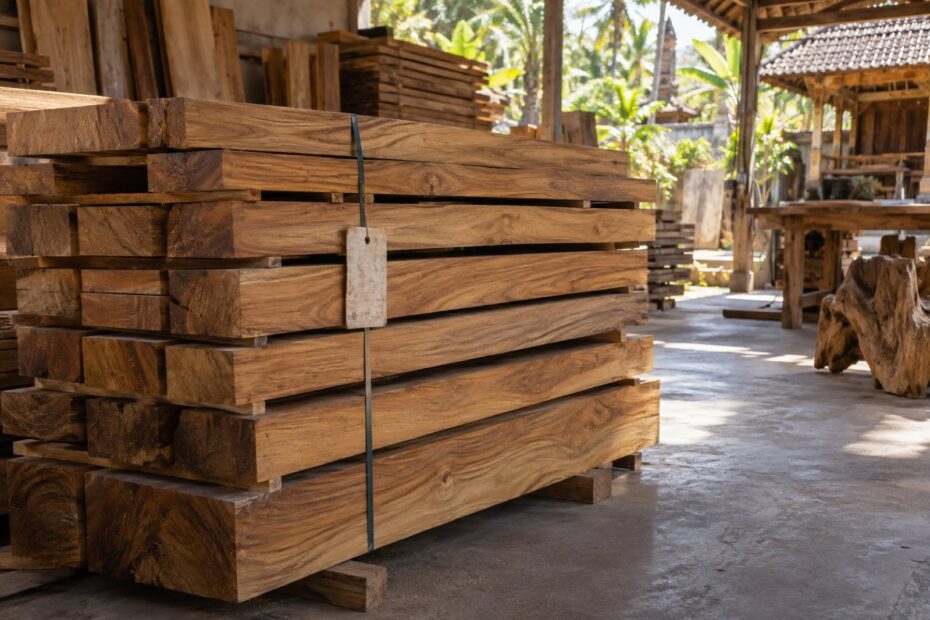
Plantation teak comes largely from Java, where plantations are managed by the state forestry enterprise Perhutani on a planting and harvesting rotation. The paperwork is the cleanest available: harvest and sawmill records and a documented chain into the workshop, which is what SVLK is built around and what an EUDR file needs. The wood is uniform in colour and grain, so a large batch of dining tables can be matched. If you are furnishing eighteen identical hotel rooms, this is your material.
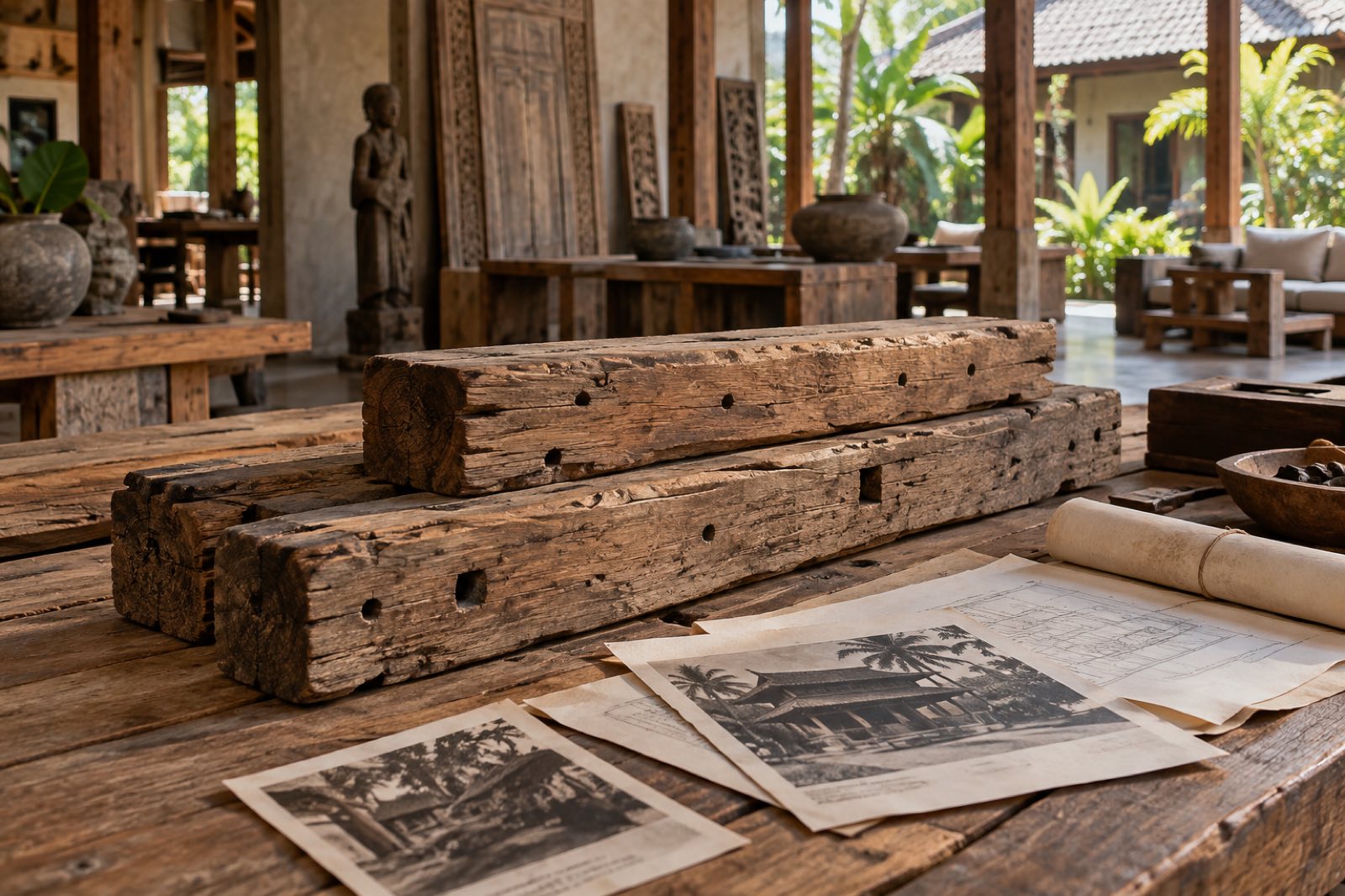
Reclaimed teak is recovered from old Javanese houses, warehouses, bridges and boats. The grain is often denser than anything a modern rotation produces, the timber has already done its dimensional moving over decades, and it carries nail holes, bolt scars and colour variation that many designers want. It is rarely cheaper: demolition, transport, denailing, metal detection, high wastage and slow milling all cost money, and reclaimed stock frequently prices level with or above plantation.
The documentation differs in kind. Reclaimed material is evidenced as recycled, with a declaration describing the source building or vessel and the recovery process, rather than a harvest plot with coordinates. As of September 2026, EUDR does not apply to products made entirely from material that has completed its lifecycle and would otherwise be discarded as waste, but “entirely” carries real weight: a reclaimed top on newly sawn legs is not entirely recycled. Ask your broker how they read it for your product.
In short: plantation for matched volume, outdoor ranges and anything that must repeat. Reclaimed for character pieces, feature tables, restaurant counters and one-off villa work where variation is the point. Our guides to teak and wood types go deeper.
Documents to request from any Indonesian supplier
Copy this into your purchase order:
- SVLK certificate number, issuing body and validity dates, for the legal entity on your invoice.
- A copy of the V-Legal Document for your shipment.
- Commercial invoice and packing list showing species and volume per line item.
- Scientific and common species names for every item, including secondary timbers.
- Country and region of harvest, plus geolocation data where EUDR applies to you.
- For reclaimed timber, a declaration of origin describing the source structure and recovery process.
- Phytosanitary certificate where required, ISPM 15 marking on timber packaging, certificate of origin and bill of lading.
- Written agreement on who submits the EUDR due diligence statement and who supplies reference numbers.
- Kiln-drying records or moisture readings for your destination climate. Not a legal requirement, but the one that saves you most money.
Importers outside the EU are not exempt. The United States requires a plant and plant product declaration under the Lacey Act, the United Kingdom operates its own timber regulations derived from the EU rules, and Australia’s illegal logging legislation requires documented due diligence. All three are easier to satisfy when the Indonesian paperwork is complete. Verify your own market’s current requirements with your customs broker before your first shipment.
Ask us for the paperwork before you ask for the price
If you are scoping an order, ask at enquiry stage what documentation will travel with it. It is an easier conversation before production than after loading. Message us on WhatsApp at +62 812-3842-178 for a documentation checklist alongside your quotation, or read about our services.