
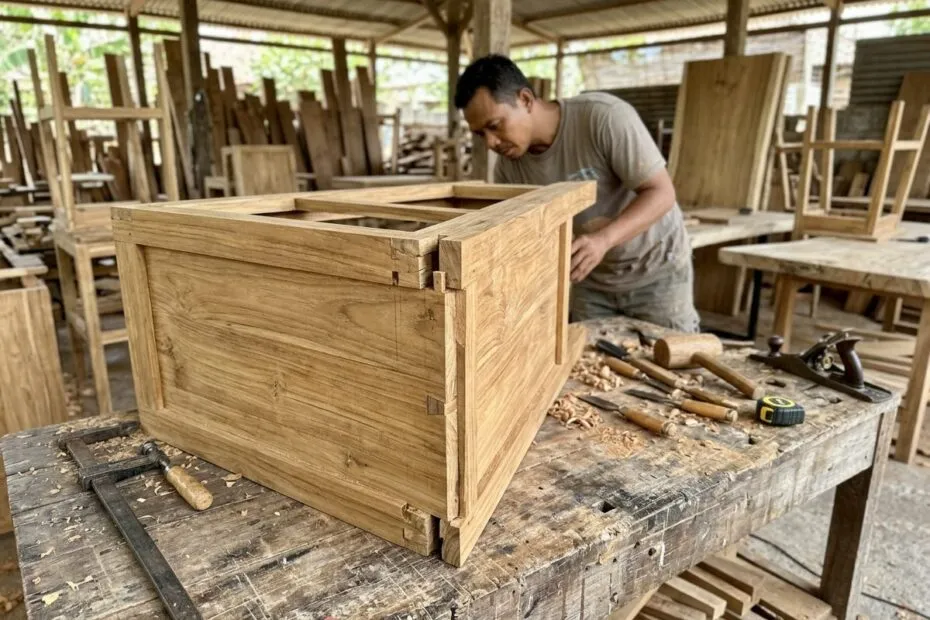
A sourcing trip to Bali works when you treat it as an audit. Plan two workshop visits a day at most, bring drawings and measurements, and spend your time on the workshop floor rather than in the showroom. Look at the timber stock, the joints on half-built pieces, the finishing area and the crates. Leave with a written quote and a sample agreement, not a handshake.
Bali has hundreds of furniture makers, from one-room carving studios to large export factories, and many more shops that sell furniture made somewhere else. A website cannot tell you which is which. Standing in the workshop can.
This guide covers the trip itself. For the checks to run before you book a flight, read our guide on choosing between a sourcing agent and a direct workshop. For the questions to settle before a first order, see how to import furniture from Bali.
Plan the days before you fly
Workshops cluster in a few areas. Gianyar regency, which takes in Celuk, Sukawati and Mas, has long been a centre for craft and woodwork. There are also makers and showrooms around Denpasar and the south. Many buyers add a few days in Jepara, in Central Java, Indonesia’s best-known furniture town.
Traffic in south Bali is slow and hard to predict. Two visits a day is realistic. Three means you see showrooms and miss the workshops.
A workable plan for a first trip:
- Days 1 and 2: first visits to your shortlist. Look, ask, photograph.
- Day 3: a free day. Sort your photos and notes, and compare what you saw.
- Days 4 and 5: second visits to your top two or three. Go through drawings, finishes and prices in detail.
- Last day: collect written quotes, agree samples, confirm next steps.
Book every visit ahead. Most serious workshops work by appointment so that someone who can answer technical questions is free when you arrive. Ask to see the production floor, not only the gallery, and confirm this when you book.
What to bring
A buyer who arrives with a clear brief gets a clear quote. Bring:
- Drawings or reference photos of each piece, with overall dimensions. A photo with a tape measure in frame is better than a photo alone.
- Room or product measurements, including door widths and ceiling heights for large pieces.
- A target price per piece, even a rough one. It tells the maker which timber grade and level of detail to propose.
- A container plan: roughly how many pieces of each design, and whether you are aiming for a 20ft or a 40ft. Our guide to 20ft vs 40ft containers for furniture helps you size it.
- Finish references: a fabric swatch, a paint chip or a photo of a finish you like, taken in daylight.
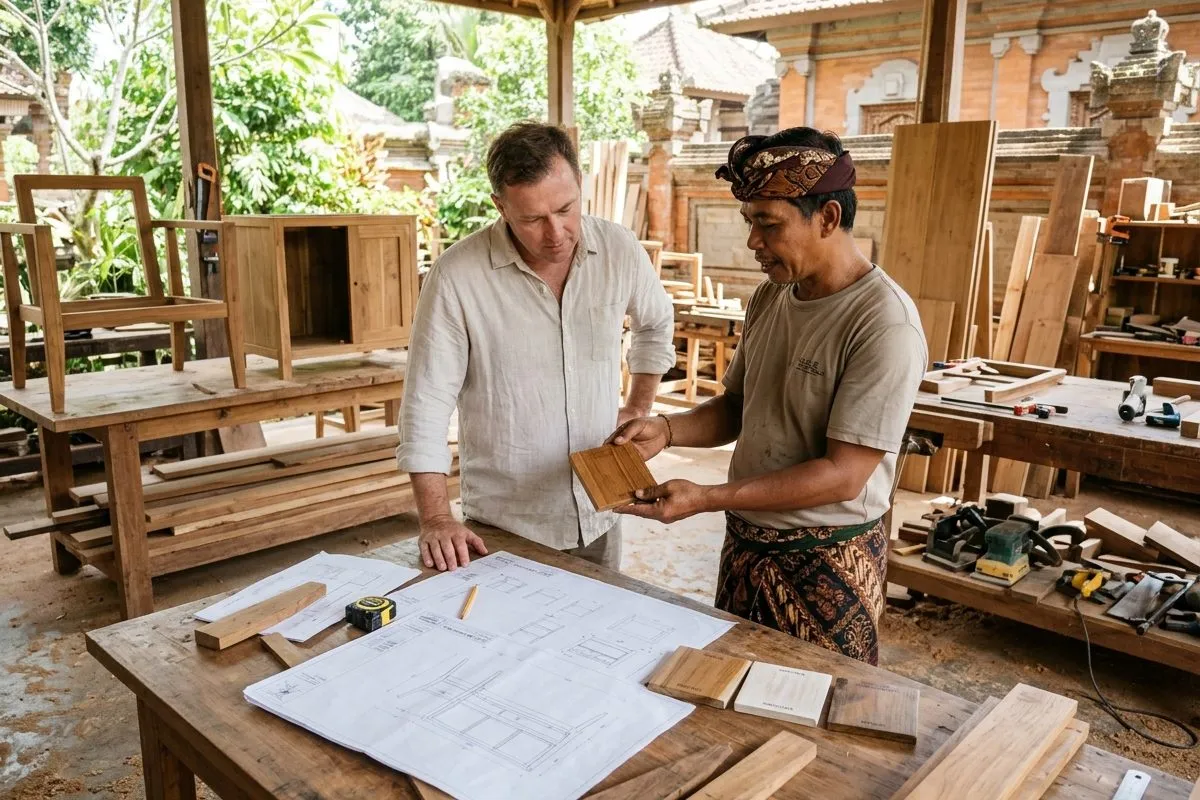
What to look at on the workshop floor
The showroom shows you the best a maker can do. The workshop shows you what they do every day.
Timber stock and drying
Ask to see where timber is stored and how it is dried. Look for stacked boards with spacers between them so air can move, cover from rain, and some way of checking moisture. Ask what moisture content they dry to for your destination and how they measure it. A maker who can show you a moisture meter and a reading has thought about it.
Check board ends for cracks. If you are buying teak, ask which grade you are looking at, and ask to see the same grade in a finished piece.
Joinery on half-built pieces
Half-built furniture is the most honest thing in any workshop. Before the finish goes on, you can see how a piece is put together. Look for mortise and tenon or dowel joints on frames and legs, rather than screws and glue alone. Look inside drawers and at the backs of cabinets. Check that drawer runners are timber or a hardware you recognise, and that panels have room to move with the seasons.
The finishing area
Ask what finishes they apply and ask to see samples on the species you are buying. A finish on teak looks different on mahogany. Look at pieces drying: is the area clean, is dust controlled, are coats even? Ask whether they keep an approved sample on file for the length of your order.
Crating and packing
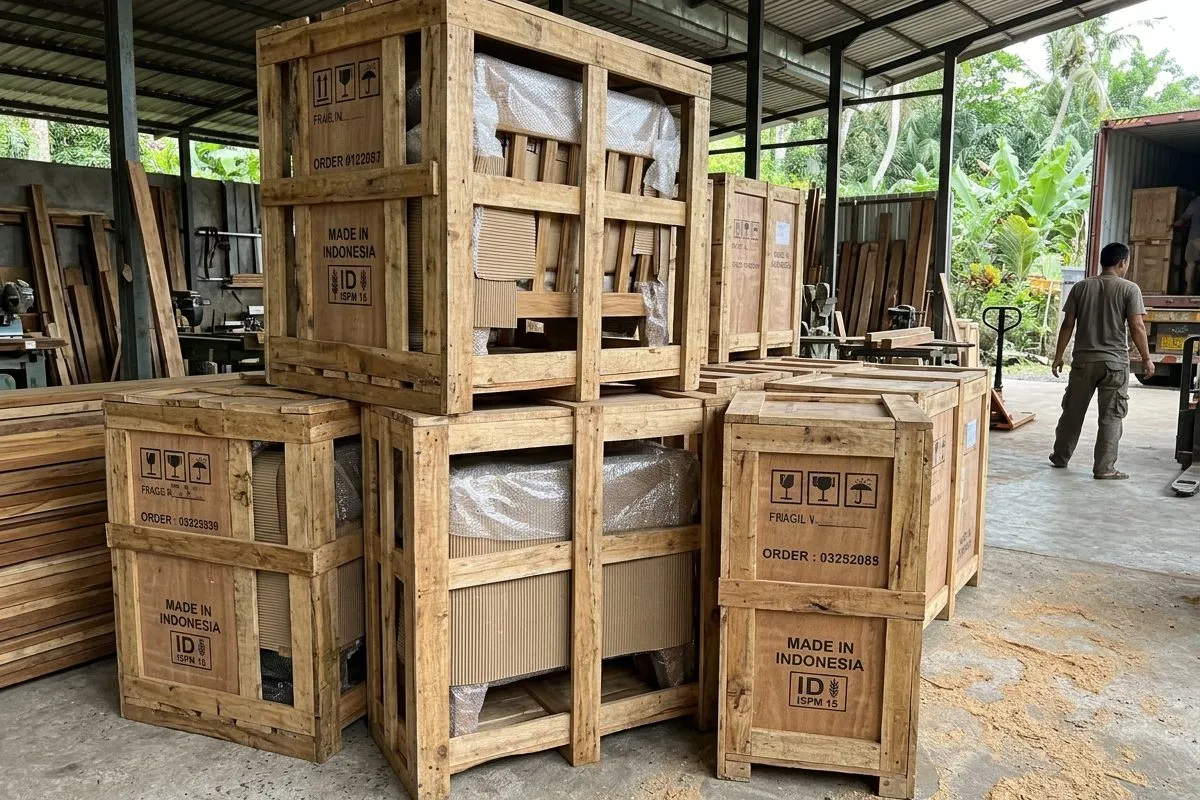
Find out where pieces are wrapped and crated. Look at a finished crate. Is it solid timber, is it braced, is it marked as treated wood packaging? Ask how they protect corners, glass and carved detail. Damage in transit usually starts with a crate that was built for a lighter piece.
Who makes it
Ask directly which stages happen on site and which are sent out. Many workshops use specialist carvers, upholsterers or metalworkers outside their walls. That is normal. What matters is that the maker knows who they are, checks their work and takes responsibility for the finished piece. A seller who cannot say where a piece was made is reselling it.
How to photograph and log what you see
You will see hundreds of pieces in a week. Without a system, they blur.
- Give every reference a code, and photograph the code next to the piece. Masking tape with “W2-07” on it works.
- Take three shots: the front, a joint or detail, and the finish in daylight.
- Log the maker’s product code, dimensions, timber, finish and any price, and mark whether the price was spoken or written.
- Each evening, move photos into one folder per workshop.
What to leave with
A good visit ends with paper. Before you fly home, aim to have:
- A written quote for each piece, stating timber, finish, dimensions, price basis (FOB or CIF) and lead time. Our article on custom teak furniture cost lists what a quote should itemise.
- A sample agreement: which pieces will be sampled, the finish, the cost and the date.
- Named contacts for production and for shipping.
- Agreed next steps with dates: when shop drawings arrive, when you approve them, when production starts.
Verbal prices given on a busy afternoon are a starting point. A written price is something you can plan a container around.
Visiting KALIUDA in Celuk
Our workshop and gallery share one address: Jl. Setra Cemenggon No.88, Celuk, Sukawati, Gianyar, Bali 80582. We are a second-generation workshop. We design, build and restore solid wood furniture in teak, mahogany, suar and reclaimed timber, we have made furniture for export since 1997, and we have shipped to 12 countries on 4 continents.
We are open Monday to Saturday, 9am to 6pm (GMT+8), by appointment. On a visit you can see finished pieces in the gallery and talk through drawings, timbers and finishes.
For export, our minimum is one 20ft or 40ft container, quoted FOB or CIF from the Port of Benoa, with a lead time of 60 to 90 days from order confirmation. Samples are available before you commit to a full order. Details are on our export and wholesale page.
Frequently asked questions
How many days do I need for a furniture sourcing trip to Bali?
Five working days is a sensible minimum for a first trip. That allows first visits, a day to compare notes, and second visits to your shortlist. If you plan to visit Jepara as well, add at least three days.
Should I visit workshops or showrooms?
Visit both, but give most of your time to the workshop. A showroom shows finished pieces. The workshop shows timber, joinery, finishing and packing, which decide how your order arrives.
Can I place an order during the visit?
You can agree the main terms on the visit, but most buyers confirm after samples are approved. Leave with a written quote and a sample agreement, then confirm the order once you have the sample in hand.
Do I need to bring technical drawings?
No. Clear photos with overall dimensions are enough to start. We can produce shop drawings for approval before production, and nothing is cut before the drawing, the price and the date are agreed in writing.
Book a workshop visit in Celuk
Send us your dates, your shortlist of pieces and your container plan on WhatsApp at +62 878-5115-1097, and we will reply within 48 hours to confirm a time. To see how we work with overseas buyers, read about us as a furniture supplier in Bali, or go straight to export and wholesale.