
Ask three Bali workshops to quote the same 2.4 metre solid teak dining table and you will get three numbers that look like they belong to three different products. The lowest is often a third of the highest. Nobody explains the gap, so most buyers choose on instinct, or on whoever replied to WhatsApp first.
That is a poor way to spend several months of a furnishing budget.
There is a reason workshops here do not publish price lists. Nearly everything is made to order, timber is bought board by board at whatever the yard is asking that month, and a printed price would be out of date within weeks. Fair enough. But the effect is that buyers cannot tell a fair quote from a bad one.
So here is the honest version. Six things set the price of custom furniture in Bali. Once you can find them on a quotation, the numbers stop being mysterious.
The six things that actually move the price
1. Species and grade of the timber
Species comes first. Teak, mahogany, suar, acacia and camelina sit at different points on the price scale and behave differently in a Bali house. Teak carries high natural oil and silica, is dimensionally stable, and is class 1 durable, which is why it is the default for anything that sees weather or humidity swings. Suar gives you wide single-slab tops. Mahogany is easier to work and cheaper, but it is not an outdoor timber. More on the species in All About Teak Wood.
Grade matters as much as species. Teak is normally sold in the trade as grade A, B or C, describing colour uniformity, knot size and how much pale sapwood is present. Grade A is heartwood only, tight and even. Grade C carries knots, wide colour variation and sapwood. That is an appearance and yield grading, not a strength grading, with one important exception: sapwood lacks the oils that make teak durable, so for anything outdoors you want heartwood whatever the label says.
Reclaimed teak, pulled from old Javanese houses and boats, is a category of its own: old growth, dense, tight ringed, full of nail holes, and priced on scarcity rather than grade.
2. Board thickness and how much solid stock the design wastes
This is the cost driver almost nobody thinks about. A workshop pays for timber bought, not timber in the finished piece.
A 40 mm table top does not cost twice a 20 mm top. It costs more than twice, because thicker boards come from bigger logs, and bigger logs are scarcer. Then the design decides how much of that board survives. A rectangular top with square edges wastes very little. A tapered leg, a curved apron, a live edge, a shaped arm or a chamfer cuts material away that you have already paid for. It is normal for a third or more of a board to end up as offcuts and shavings on a shaped design.
Ask any workshop how thick the stock is and whether the price assumes solid throughout. Those two answers explain a large part of the gap between quotes.
3. How it is jointed
Joinery is time, and time is most of the labour cost.
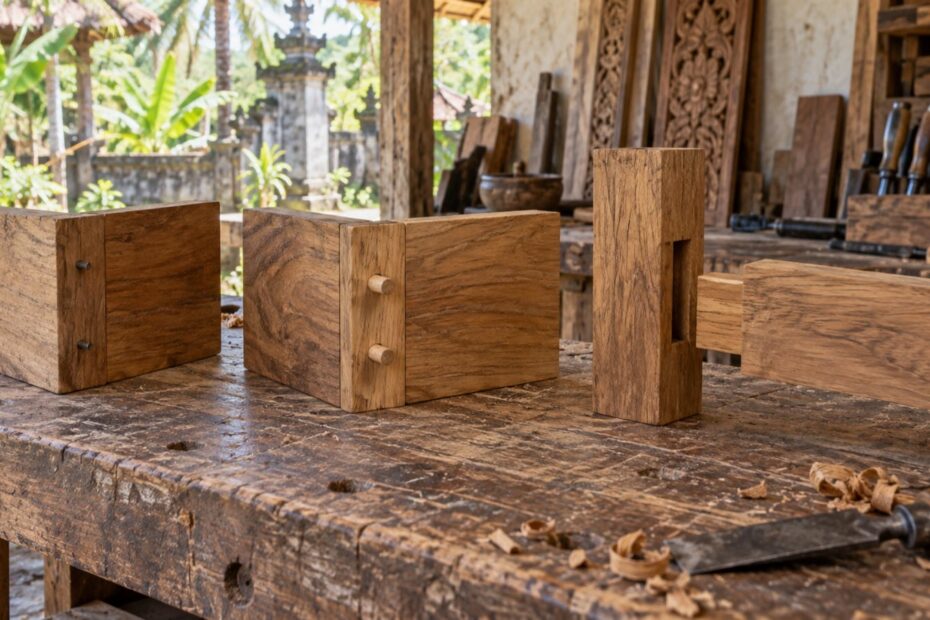
A cut and fitted mortise and tenon takes a joiner far longer than a dowel, and a dowel takes longer than a screw driven through the face and filled. All three can look identical once the piece is finished and the filler is sanded. Only one of them is still tight after five years of a tropical wet season followed by an air-conditioned bedroom.
If a piece is destined for a container, ask whether it is built knock-down with bolted fittings or as a fixed frame. Knock-down costs more to engineer and saves a great deal in freight volume.
4. The finish
Finish is not a single line item, it is a stack of decisions: how far the sanding goes, whether the piece is stained or colour-matched, which system goes on top, and how many coats.
A natural oil or hard wax finish is repairable at home and suits Bali’s humidity, but needs refreshing. Water-based polyurethane is tougher and lower odour. Solvent lacquer builds a fast, hard film and is cheaper to apply, but is unforgiving when it chips. Colour matching adds sampling time, and a distressed finish is hand work on every surface. Our Color Chart & Material Knowledge page shows the same timber across finishes.
5. Hardware and upholstery
On casegoods, hardware is a real percentage of the price. Soft-close runners and quality hinges cost several times the loose-fitting alternatives, and they are what you touch every day.
On upholstery, the variables are foam density, webbing versus springs, the fabric metreage the design consumes, and whether that fabric is a standard interior cloth or a solution-dyed outdoor one. Two sofas of identical size can differ enormously on this line alone.
6. One-off or repeat
A single piece carries the whole cost of the drawing, the setting out, the jigs and the first-time problem solving. The second and third units of the same design do not. If you are furnishing a villa with six identical bedside tables, say so at the enquiry stage: it changes the number.
The same table, quoted three ways
Here is what those three quotes usually contain. The specification differences are real; the figures are the client’s to fill in.
| Line | Quote A (budget) | Quote B (middle) | Quote C (workshop grade) |
|---|---|---|---|
| Top | 20 mm teak veneer on blockboard | 25 mm solid teak, glued panel | 40 mm solid teak, grade B, matched boards |
| Moisture content | Not stated | “Air dried” | Kiln dried, stated on the quote |
| Frame and legs | Mixed hardwood, stained to match | Solid teak, dowelled | Solid teak, mortise and tenon |
| Apron fixing | Nailed and filled | Screwed, no blocks | Jointed with corner blocks |
| Finish | One coat spray lacquer | Two coats PU | Sanded fine, three coats, edges eased by hand |
| Guarantee | None offered | Verbal | Written, with a repair path |
Quote A is not a scam. It is a different product wearing the same words. The problem is that the quotation does not say so.
Why the cheapest quote is usually the most expensive one three years later
Three failures account for most of the furniture we are asked to repair.
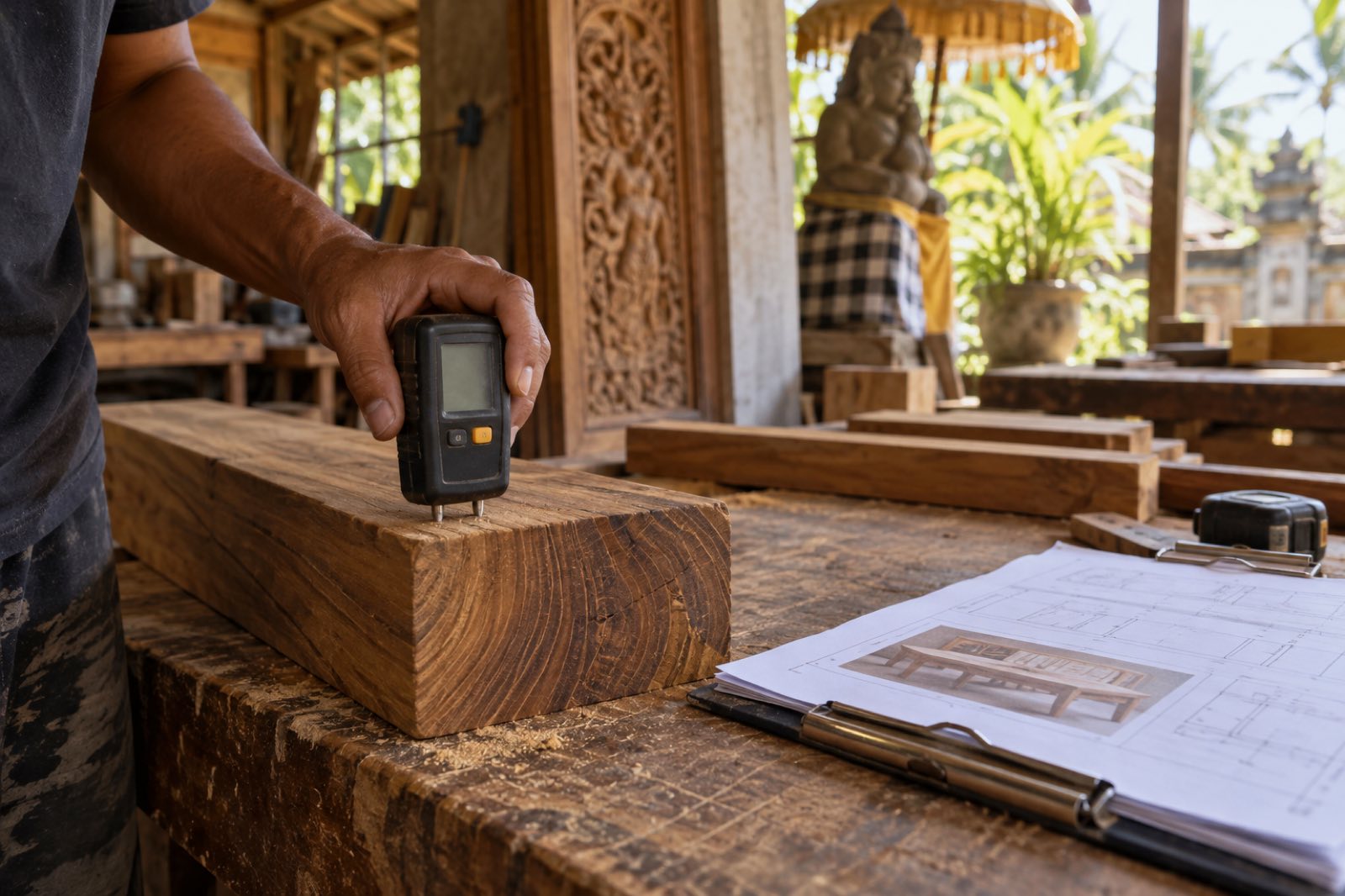
Green timber. Wood that was not dried properly keeps moving. In Bali it will cup, check and open at the glue lines, and no finish hides it. Kiln-dried stock is typically brought to around 8 to 12 percent moisture content, and a piece staying in humid Bali should be acclimatised differently from one bound for a heated European house. If the quote does not mention drying, assume nothing was done.
Veneer over blockboard. A veneered top can be perfectly good furniture when it is honestly described and well made. It becomes a problem when it is sold as solid teak, because the first deep scratch or water mark cannot be sanded out. You get one repair, at most.
Nails instead of joints. A nailed and filled frame is rigid on delivery day. Then the timber moves, the nail loses its grip, and you get the wobble that no amount of tightening fixes, because there is nothing to tighten.
What a proper quotation should itemise
Print this and hold any quote against it. If more than three lines are missing, ask before you pay a deposit.
- Timber species by name, and grade, for every component.
- Whether each part is solid or veneered, stated part by part.
- Board thickness of tops, legs and shelves in millimetres.
- Drying method and target moisture content.
- Joinery method at the main junctions.
- Finished dimensions, with a tolerance.
- The finish system, the colour reference, and the number of coats.
- Hardware brand or type, including runners and hinges.
- For upholstery: foam density, suspension type, fabric name and metreage.
- Lead time in weeks, and what starts the clock.
- Delivery, installation and, where relevant, crating and freight, priced separately.
- Payment terms, and what the deposit secures.
- What happens if something is wrong on delivery.
Talk to us before you compare quotes
We build to order in our Celuk workshop and are happy to price a piece line by line, including the parts that make us more expensive than the shop down the road. Typical lead time is four to eight weeks, and there is no minimum order.
Send a drawing, a photo, or a sketch on a napkin to WhatsApp +62 812-3842-178 and we will reply within 48 hours. Gallery visits are by appointment. The full scope of what we make is on our services page; if you are still at the looking stage, start with Buying Furniture in Bali.