

The hardest conversation we have is never about a broken joint. It is about a crack. A client unpacks a solid teak dining table in London or Melbourne in January, puts it in a flat with underfloor heating, and eight weeks later sends a photograph of a hairline split running out from the centre of the top.
Nothing was made badly. The table was built for one climate and moved to another, and nobody wrote the moisture requirement into the specification. It is the most common failure in exported solid timber furniture, and it is entirely preventable.
Equilibrium moisture content, in plain terms
Wood is hygroscopic: it absorbs and releases water vapour until it reaches equilibrium with the air around it. That balance point is the equilibrium moisture content, or EMC, and it is set almost entirely by relative humidity.
The practical consequences are simple. In Bali, where humidity sits high year round, timber in an open-sided villa settles around 13 to 16 per cent moisture content. In a heated European or North American interior in winter, the same timber wants to sit at 6 to 8 per cent. A table made and finished at Bali’s ambient level will lose several per cent of its moisture there, and it does that by shrinking. If the construction does not allow the shrinkage, the wood splits instead.
It runs the other way too. Furniture kiln-dried hard for export and then installed in an open-air Bali villa takes up moisture, swells, and jams drawers and doors that fitted perfectly in the workshop.
So the first question in any specification is not “is it kiln-dried?” It is “where is this piece going to live?”
Air-dried, kiln-dried and “dried enough”
Three terms get used loosely, and only one of them is a specification.
Air-dried timber has been stacked and stickered under cover until it stops losing moisture to the surrounding air. In Bali that plateau is roughly 15 to 18 per cent. Air drying is slow, gentle and produces good stable stock, but it cannot go below local ambient, so it is never adequate on its own for a piece bound for a heated interior.
Kiln-dried means the timber has been through a controlled schedule that takes it below ambient and, done properly, relieves the internal stress drying creates. For export furniture the norm is roughly 8 to 12 per cent moisture content. That is not a marketing phrase, it is a target you can meter and check.
“Dried enough” is what you get when nobody wrote a number down. It usually means the surface reads low and the core is still wet: the piece moves after it leaves the workshop.
Ask for a moisture reading taken on the actual components at assembly, not on incoming stock, and ask where it was taken, because end grain and face grain read differently. Be specific about the destination band: 8 to 10 per cent for a heated northern interior, 10 to 12 per cent for a temperate or air-conditioned interior, 12 to 14 per cent for an open-sided tropical villa.
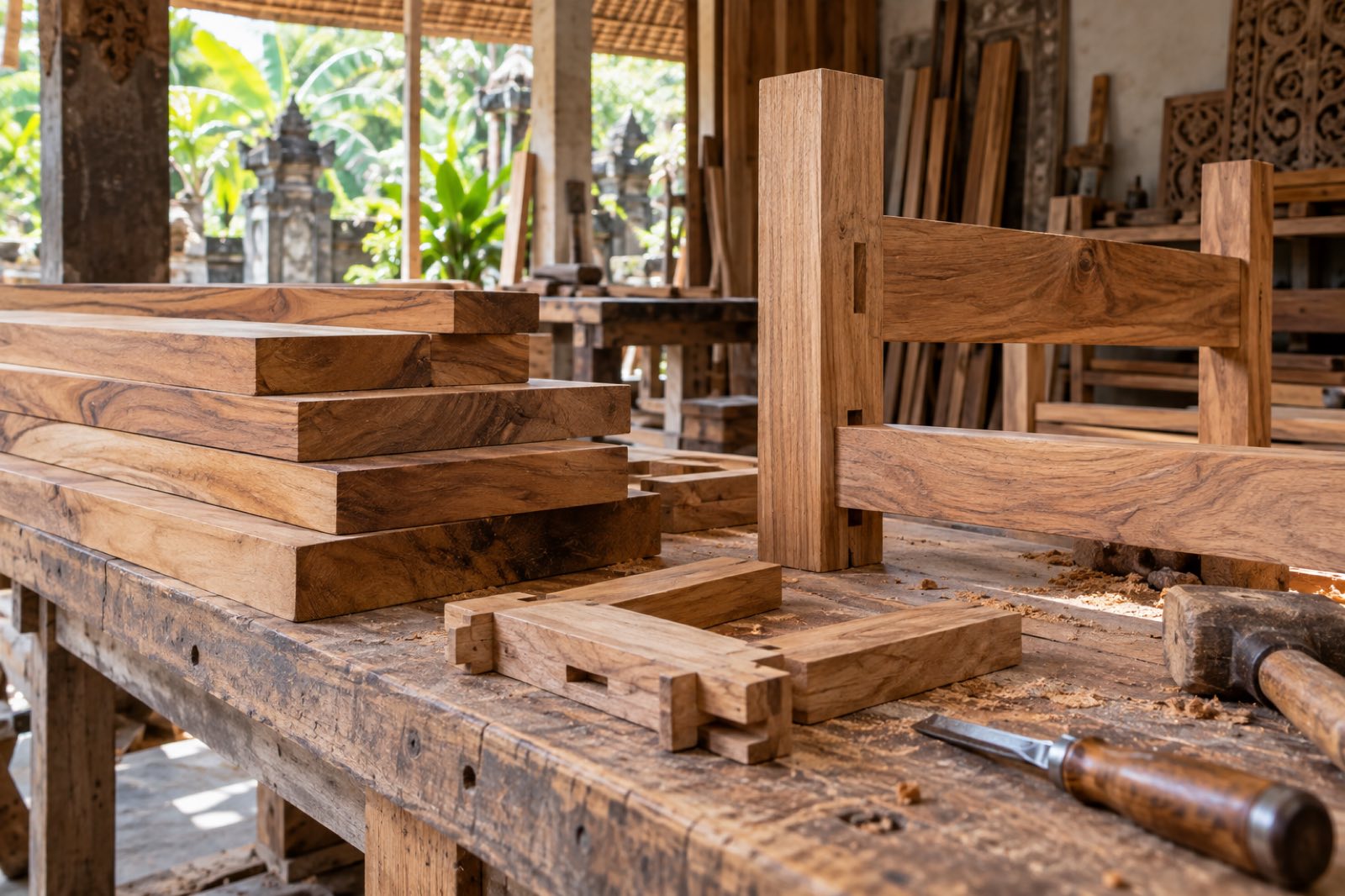
How wood moves, and which direction matters
Solid timber moves almost entirely across the grain. Along the grain, movement is so small you can ignore it in furniture. That asymmetry drives every good joinery decision.
As a working rule, expect a solid top to change by roughly half to one per cent of its width between a humid tropical wet season and a dry heated winter. On a 1 metre (39 in) wide top that is 5 to 10 mm of real movement; on a 1.2 metre top, 6 to 12 mm. Teak is one of the more stable hardwoods, which is why it has been used for boat decks and export furniture for two centuries, but stable does not mean static.
The design consequence: a solid top must be free to expand and contract across its width while everything holding it stays put. Every detail below exists for that reason.
Breadboard ends
A cross-grain batten on each end of a solid top keeps it flat and hides the end grain. Because it runs at ninety degrees to the top, it cannot move with it. The correct detail glues and pins only the centre tenon and lets the outer pegs sit in elongated slots, so the top can grow and shrink either side of a fixed middle. A breadboard end glued along its full length is a guaranteed split, usually in the first dry season.
Floating panels
Any framed panel, whether a cabinet door, carcase side or bed headboard, should sit loose in its groove rather than glued in. Leave space at the groove bottom and no glue on the panel edges. If the panel is finished before assembly, the line that appears when it shrinks will not show as a pale stripe.
Elongated fixing slots on solid tops
A solid top fixed to a base with screws through round holes will crack. Fix through slots running across the grain direction, or use buttons or figure-of-eight fasteners that allow slip. Locate the fixed point near the centre so movement is shared to both edges rather than pushed to one end.
Why a 2.4 m table is not a scaled-up 1.2 m one
Movement scales with width, not length, so a 1.2 m and a 2.4 m table of the same width move the same amount across the top. What changes with length is deflection, joint loading and handling stress. A 2.4 m solid slab needs deeper aprons or a stretcher to control sag, a base spaced so it does not restrain the top at two distant fixed points, and thought about how it will be crated and carried without racking the joints. If it is wider as well, add the extra movement allowance to the fixing detail.
The joinery hierarchy
If you specify nothing, you get the cheapest joint that survives the showroom. Write down what you want.
| Joint | What it is | Where it belongs | Honest expectation |
|---|---|---|---|
| Mortise and tenon, pegged or drawbored | Interlocking joint with long glue faces and mechanical lock | Chair and table frames, doors, anything carrying load | Decades. The benchmark for solid timber |
| Loose tenon / Domino | Machined slot with a floating tenon | Frames, carcase joints, repeatable production | Very good when sized properly, close to a fixed tenon |
| Dowel | Round pins in drilled holes | Light frames, secondary components | Adequate, but limited glue area; loosens under racking |
| Pocket screw | Angled screw into a drilled pocket | Concealed carcase work, non-structural | Fast and cheap, will not survive repeated racking loads |
| Nailed and puttied | Pin nails plus filler | Should not appear in specified furniture | Fails visibly, and the filler shrinks and telegraphs |
What to put in your specification document
Copy this into your FF&E schedule and you will remove most of the risk before a single board is cut.
- Species and grade by botanical name, not just trade name, and whether reclaimed or plantation stock is acceptable.
- Target moisture content at dispatch, as a band, with the destination climate stated (for example: 8–10%, destination heated interior, UK).
- How and where moisture is measured, and that the reading is recorded per order.
- Joinery method by component, using the hierarchy above. State explicitly if pocket screws and nailed joints are unacceptable in visible or load-bearing work.
- Movement details: breadboard ends slotted, panels floating, tops fixed with slots or buttons, fixed point central.
- Maximum panel and top widths before a glue-up is required, and whether you accept a laminated top over a single slab.
- Finish system and whether all faces, including undersides and drawer interiors, are sealed. Sealing one face only causes cupping.
- Hardware: material, finish and corrosion grade, especially for anything near the coast.
- Sample and prototype requirements: finish samples on the actual species, and a first-off approval before batch production.
- Packing and acclimatisation guidance to be issued to the end client with the delivery.
That last one costs nothing and saves the most arguments. Solid wood does not need to be treated gently, it needs to be allowed to move.
Send us the drawings
We build to order in Celuk, Sukawati, and we are used to reading FF&E schedules rather than guessing from a mood board. Send your drawings, your schedule and the destination climate, and we will come back with a build specification, timber options and a lead time. Typical custom lead time is four to eight weeks; container export runs 60 to 90 days. See our design, consultancy and project management services or message us on WhatsApp: +62 812-3842-178, reply within 48 hours.