
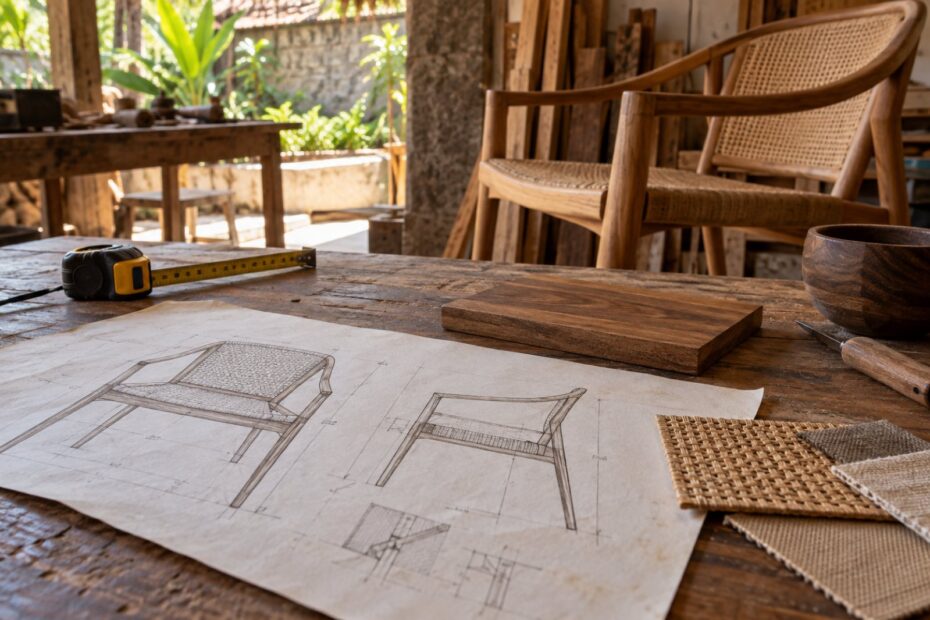
A lot of the enquiries we receive open with an apology. “Sorry, this is probably a silly question, but do you need a proper drawing?” Or: “I only have a photo from Pinterest, is that enough to start?”
Nobody should feel awkward about commissioning furniture. It feels intimidating simply because most people have only ever bought furniture that already existed. So here is the whole process, stage by stage, in the order it actually happens, including the parts where you have to make decisions and the parts where a change will cost you money.
What a workshop needs before it can quote you
A quotation is not a guess. Give us these seven things and you will usually get a real number back instead of more questions.
- Dimensions. Length, width, height, in millimetres or centimetres. If it must fit a specific space, tell us the space as well as the piece.
- A drawing or a reference photo. More on the difference below.
- Quantity. One dining table prices differently from twelve of them, and a repeat batch differently again.
- Timber species. Teak, mahogany, suar, acacia and camelina behave and price differently. If you are unsure, say what the piece is for and let us suggest.
- Finish. Even “matte, natural colour, not too dark” is enough to start. Our Color Chart & Material Knowledge page is the fastest way to give us a reference.
- Your deadline. The real one, including the day the villa opens or the shipment must leave.
- Delivery address. Ubud, Jakarta and Rotterdam are three completely different logistics answers, and it changes how a piece should be built and packed.
We have no minimum order for custom work, so a single side table is a legitimate enquiry, not a nuisance.
Reference photo versus drawing: how much detail is enough
A reference photo tells us what you like. A drawing tells us what to build. Both are useful, and you do not need to be an architect to give us something workable.
A clear reference photo is enough when the piece is a familiar type, you can give us the three key dimensions, and you are relaxed about the details being interpreted in our own way. A dining bench, a slab table, a bed frame.
A drawing earns its keep when there are internal components, when the piece must align with joinery or appliances, when there are drawers, doors or hardware, or when there is more than one of something and consistency matters. Elevations plus one section answer most of a workshop’s questions. A CAD file is welcome and never required.
Say what matters most. If the height is fixed by a countertop, say so. If the width can flex 30 mm to suit the boards, say that too. A designer who marks the two critical dimensions and lets us optimise the rest usually gets a better piece back, because solid timber comes in the widths nature gave it.
If you have neither, we can measure the room and draw for you. That is what a design and project management service is for, and there are examples on our completed projects page.
The sampling stage
Once the quotation is agreed, samples come before anything is cut.
Timber samples show you the actual species and grain, not a stock photo. Finish samples are the important ones, applied to that same species so you see the real result. On washes and antique finishes the sample is not a suggestion, it is the contract. Hardware, fabric and stone samples where they apply.
Approve them in writing, even if writing means a WhatsApp message saying “sample B approved”. We keep the approved sample in the workshop for the life of the job, so what leaves the bench can be compared with what you signed off.
Prototype or first-off approval
For a single piece, the piece is the prototype and we will send photographs at the white wood stage, before finishing, while changes are still cheap.
For any quantity, ask for a first-off. One complete unit, fully finished, made and approved before the rest go into production.
This feels like an expense and a delay. It is neither. It is the cheapest insurance in the process, and it is worth paying for even on a repeat order: timber is a natural material, batches vary, and a finish recipe reproduced eleven months later on different boards will not be identical. Approving one chair costs a few days. Finding the problem in a container of forty-eight chairs costs a season.
Documents and decisions checklist
| Stage | You provide | You receive | Locked at this point |
|---|---|---|---|
| Enquiry | Dimensions, drawing or reference, quantity, species, finish, deadline, address | Quotation and lead time | Scope and price |
| Order confirmation | Approval and deposit | Production slot | Specification and schedule |
| Sampling | Written approval | Timber, finish, hardware samples | Colour and material |
| Prototype / first-off | Written approval | Photos or one finished unit | Construction and finish |
| Production | Answers to questions | Progress photographs | Changes now cost money |
| Pre-delivery | Address and access details | QC photos before crating | Condition on despatch |
| Delivery / installation | Site access, a clear room | Piece positioned and checked | Handover |
| Aftercare | Normal maintenance | Care instructions | — |
What happens during production, and what you should see
Typical lead time for custom work is four to eight weeks depending on complexity, quantity and how quickly samples are approved. Container-scale export orders run longer, usually 60 to 90 days.
Expect progress photographs at the milestones that matter: timber selected and dimensioned, carcass assembled in white wood, finish applied. Three sets of photos on an ordinary job, not a daily feed. A supplier who goes quiet for four weeks and then delivers is showing you a warning sign, not a workflow.
We reply to messages within about 48 hours, and honest updates include the bad ones. If a board fails after machining, or wet-season humidity slows a finishing schedule, you are better off knowing in week three than in week eight.
What changes cost money, and what does not
Being straight about this saves everyone a difficult conversation later.
Usually free, if raised early: finish shade adjustments before the finish is mixed, hardware swaps before purchase, delivery date shifts of a week or two, small dimensional tweaks before timber is cut.
Costs money: any change after cutting has started; a change of species; a change of finish after the piece is finished, which means sanding back and starting again; adding drawers, doors or structure; a size change once components are machined. A finished piece that must be re-finished is close to starting over, because the labour is in the preparation, not the coating.
The rule of thumb: before cutting, changes are cheap. After cutting, changes are a new piece with a discount for the timber already bought.
QC, crating, delivery and installation
Before anything is packed we check dimensions against the approved drawing, finish against the approved sample, drawer and door operation, stability on a level floor, and the underside and back, where a shortcut hides if there is one.
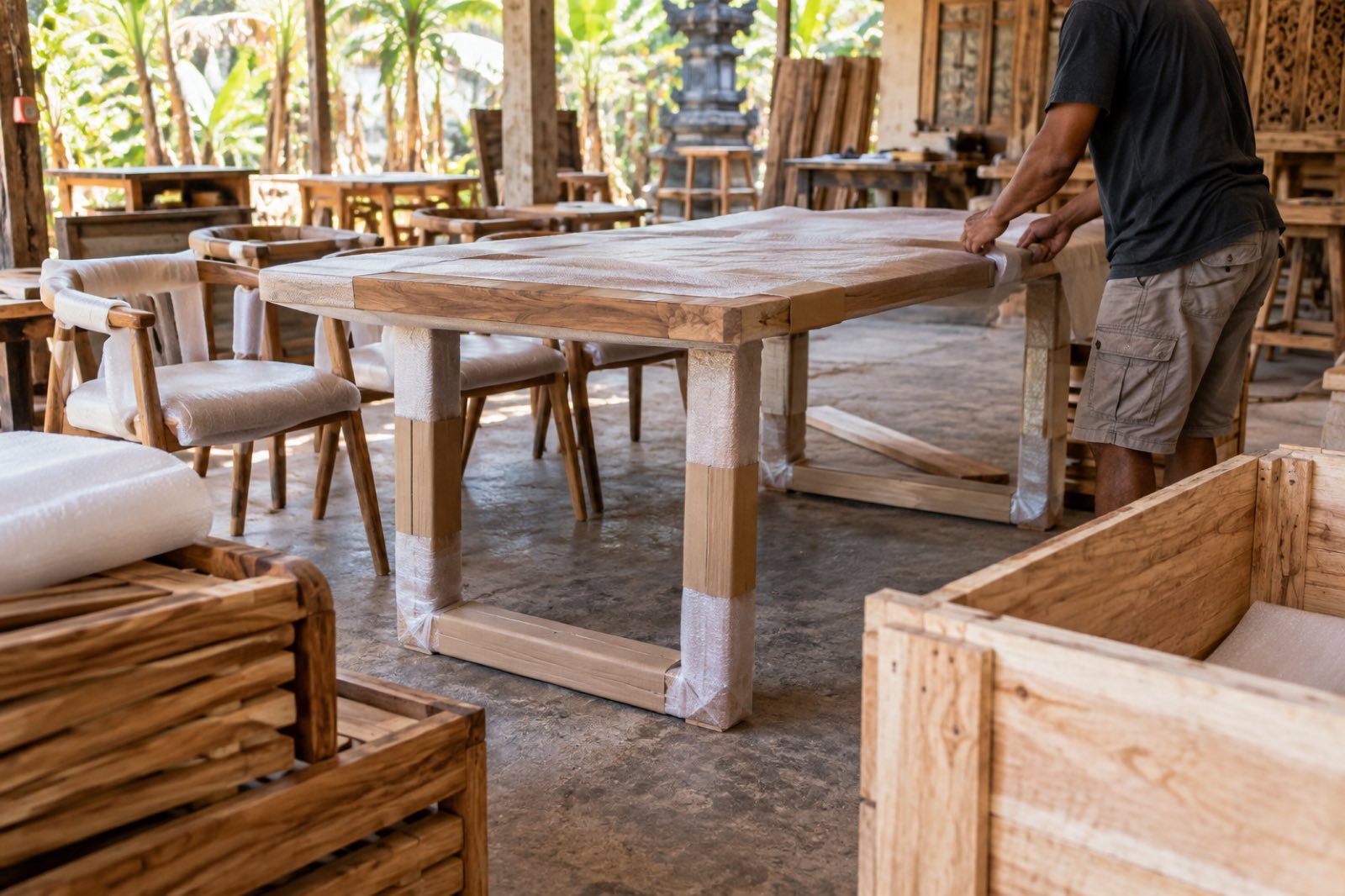
Local Bali deliveries are usually blanket-wrapped and delivered by our own team, positioned in the room, unwrapped and checked with you present. Export pieces are wrapped, corner-protected and built into timber crates for container or air freight, packed on the assumption that handling will be rough.
Tell us about access before delivery day. Narrow gates, tight staircases, lift dimensions and rice-field footpaths are all normal in Bali and all solvable, as long as we know before the truck is loaded.
Aftercare and what a warranty on solid wood really means
Solid timber moves. It expands and contracts with humidity for its whole life, and a well-made piece is built to allow it. Small movement at a joint, a hairline check in end grain, or seasonal change in a tabletop’s width are characteristics of the material, not defects.
What a workshop should stand behind is workmanship: joints that fail, finishes that lift or blister, hardware fitted badly. What no workshop can stand behind is a solid wood table placed over floor heating, or a piece acclimatised for Bali moved into a dry, heated European interior with no time to adjust.
We also repair and refinish solid wood, including pieces we did not make.
Send us your drawings
If you have a drawing, send it. If you have a photograph and three dimensions, send that. If you have a room and an idea, we will come and measure. Message us on WhatsApp with whatever you have and we will tell you honestly what is missing before we quote. If you are furnishing a whole villa, our note on custom made furniture for a villa project shows how the same process scales. Our gallery and workshop in Celuk, Sukawati is open by appointment, and there is more on our services page.