
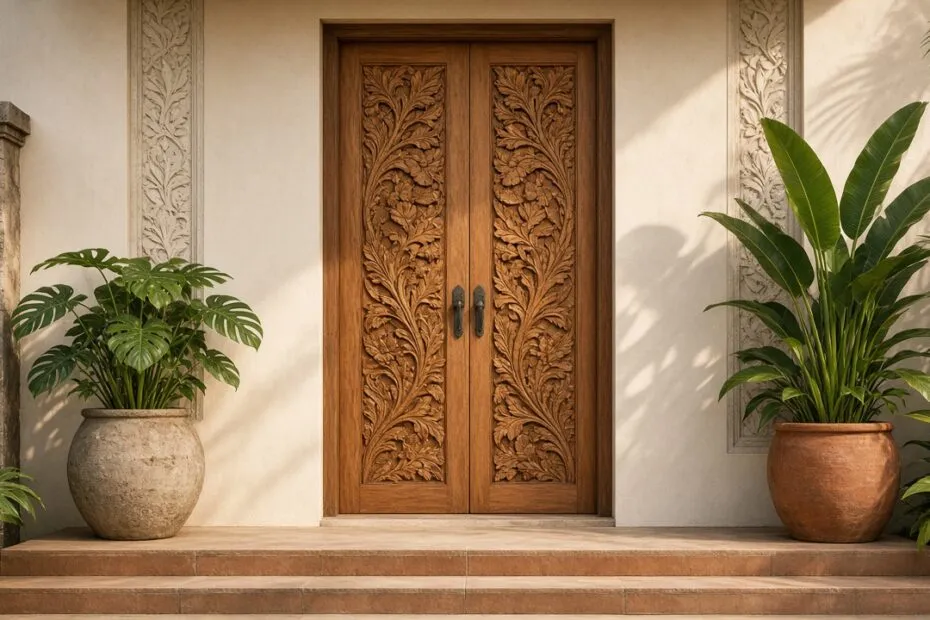
A good carved wooden door starts with the timber, the size of the opening and the finish, not the pattern. Teak is the safest choice for an entrance exposed to weather. Mahogany and suar suit sheltered and interior doors. Measure the opening before choosing a design, and decide whether you need the frame as well as the door leaves.
Carved doors are one of the most recognisable pieces of Balinese and Indonesian woodwork. They can be the first thing guests see at a villa, a statement between two rooms, or a piece of art in their own right. This guide explains how to choose one, what to ask before you order, and how to look after it.
Where a carved door works
- Main entrance. The classic use. The door carries the first impression of the house and takes the most weather.
- Interior doors. Between a living room and a bedroom wing, or into a study. Interior doors can be lighter and more decorative because they do not face sun and rain.
- Gates and courtyard entries. Common in Balinese architecture, where the gate frames the passage into a compound.
- As decoration. An antique-style door panel can become a headboard, a wall piece or a cabinet front.
Choosing the timber
We make carved doors in teak, mahogany, suar or reclaimed timber. Each behaves differently.
- Teak has natural oils that help it resist moisture, which makes it the safest choice for an external door in Bali or any humid or coastal climate. It carves cleanly and holds fine detail.
- Mahogany has a fine, even grain that carves well and takes stains and painted finishes. It is best for interior doors or doors under a deep roof overhang.
- Suar is chosen for its wide, figured grain. It suits interior doors where the timber itself is the feature, rather than deep carving.
- Reclaimed timber gives an aged character from the start, with variation in colour and texture. See reclaimed teak for what to expect.
Our guide to Balinese wood furniture carving explains which timbers carve best and how relief depth affects cost.
Single, double, with or without a frame
Doors come in many arrangements, and the catalogue shows most of them: single doors, double doors, doors with carved transoms above, doors with side panels, and doors supplied complete with their frame.
- Single door. The simplest to fit into a standard opening.
- Double door. Gives a grander entrance and a wider opening. Check that each leaf is still a comfortable width to use.
- With frame. A door supplied with its own frame is easier to fit correctly, because the door and frame are made and checked together. It is also where much of the carving often sits.
- With transom or side panels. Carved or fretwork panels above or beside the door add height and light without making the leaves heavier.
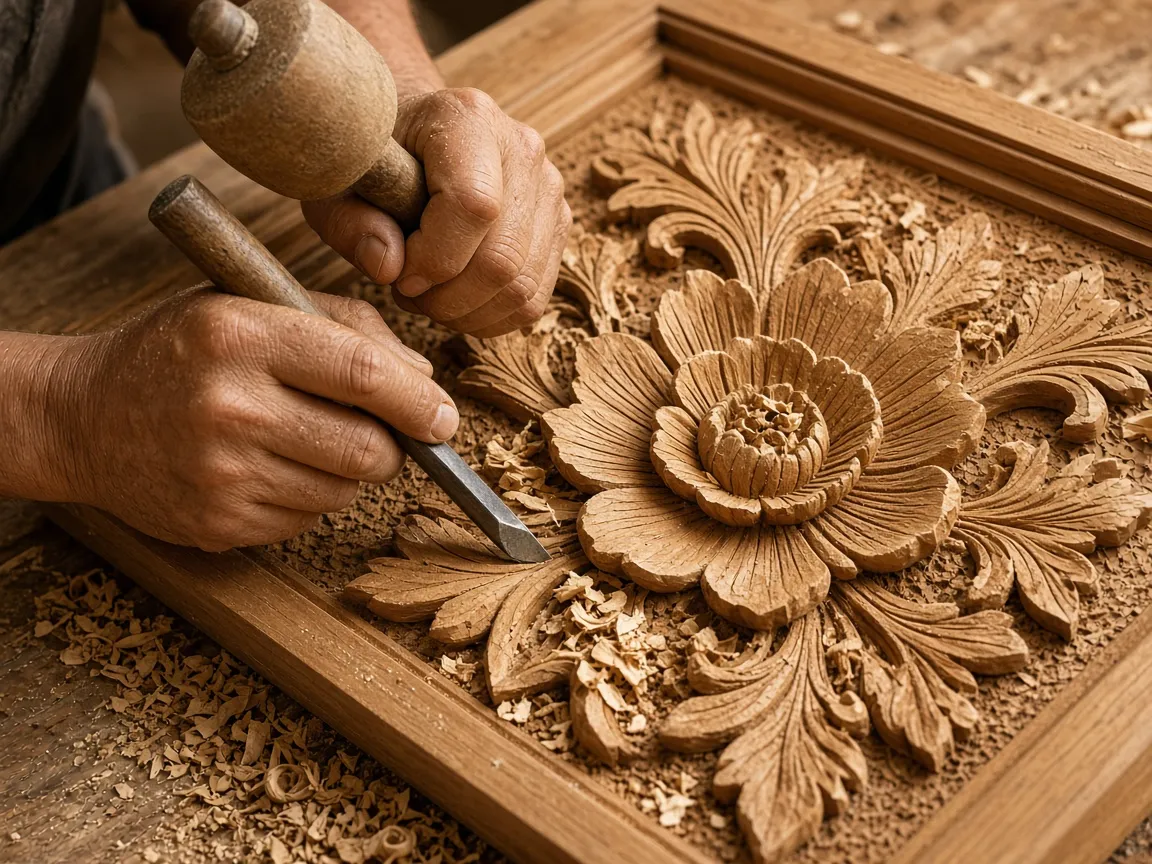
Measuring the opening
Most problems with doors start with a measurement. Before you choose a design:
- Measure the width and height of the opening at several points. Walls are rarely perfectly square.
- Decide whether you are measuring for the door leaves only or for the door and frame together.
- Note the wall thickness if you want a full frame.
- Note which way the door should open and where the hinges go.
Every door in our catalogue of carved Balinese doors lists its reference and, for many, its overall size. Any of them can be made again in your size, timber and finish.
Finishes for carved doors
We offer natural oil, matte PU, white wash and antique finishes. Ask us about painted colours for the design you like. On a carved door the finish does two jobs: it protects the wood and it changes how the carving reads.
- Natural oil keeps the warmth of the timber and is easy to refresh, but needs re-oiling more often outdoors.
- Matte PU gives stronger protection with a low sheen.
- White wash softens the wood and lets shadows define the carving.
- Antique darkens recesses so the pattern stands out.
- Painted or washed colours, such as turquoise, green or blue, are traditional on many Indonesian doors and give a weathered, island character. Ask us whether a painted finish suits your door.
Read wood finishes explained for how each one looks on teak, suar and mahogany.
Installation and care
A solid wood door is heavy. It needs strong hinges, a well-fixed frame and an opening that is square. Our older post on how to install teak doors covers the basics. For delivery or fitting in Bali, ask us what we can arrange for your project. Overseas buyers order doors by the container, FOB or CIF from the Port of Benoa.
For care, dust the carving with a soft brush, wipe the surface with a slightly damp cloth, and refresh oiled finishes when the wood looks dry. Exterior doors last longer under a roof overhang that keeps off direct rain. Our teak care calendar applies to doors too.
Frequently asked questions
Which wood is best for an exterior carved door?
Teak, because its natural oils help it resist moisture. Mahogany and suar are better kept for interior or well-sheltered doors.
Can I order a carved door in my own size?
Yes. Any door in the catalogue can be made in your size, timber and finish.
Can carved doors be exported?
Yes, by the container: FOB or CIF from the Port of Benoa, from one 20ft or 40ft container.
Can I see the doors in person?
Yes, at our gallery in Celuk, Sukawati, by appointment, Monday to Saturday, 9am to 6pm.
Ask about a door
Browse the carved doors catalogue, then send us the reference or number of the door you like, with the size of your opening, on WhatsApp at +62 812-3842-178. We reply within 48 hours with sizes, finishes and pricing. Price and lead time are confirmed in writing before anything is cut. Trade buyers can order through our export division, and you can read more about us as a Bali furniture supplier and manufacturer.