
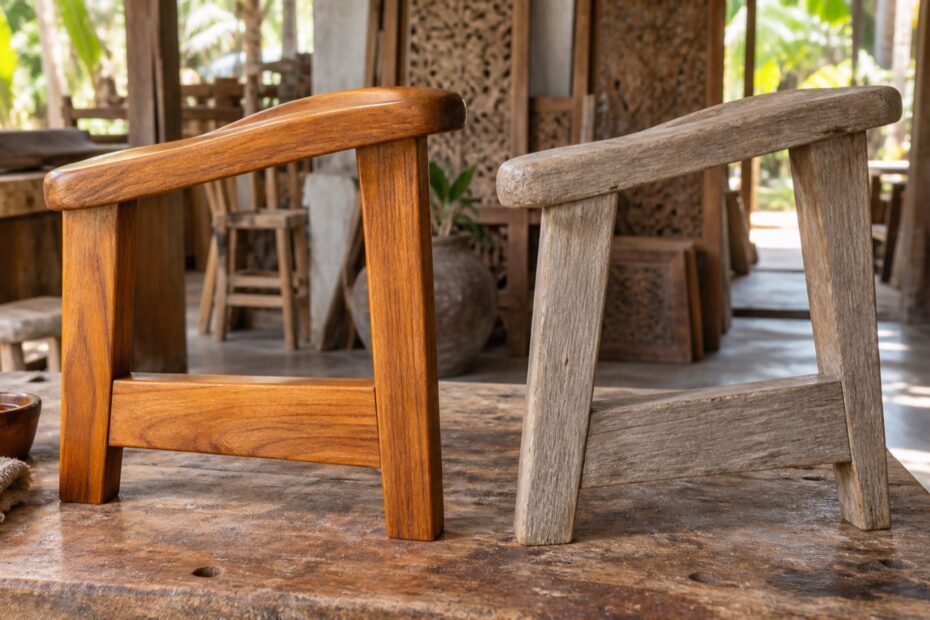
There is a message that reaches us most years around March, and it is almost always a photograph. A teak daybed beside a pool, bleached to a patchy grey, black spotting along the arms, and one leg with a split you could slide a coin into. The caption is a version of the same question every time: it was fine last year, so what happened?
What happened is that “outdoors in Bali” is not one set of conditions. It is at least three, and each ruins furniture differently. A bench that lasts fifteen years in a shaded Ubud courtyard can look exhausted after two seasons on an exposed pool deck above Uluwatu. Before you choose a timber, choose the exposure.
Bali has three outdoor climates, not one
Full sun, poolside
Equatorial UV, a deck surface at two in the afternoon that makes you pull your hand back, and then a downpour at four. The damage is cyclical rather than dramatic. The surface dries and shrinks while the core stays wet, and the timber relieves that stress by opening fine cracks along the grain. Furniture makers call this checking. It is normal in small amounts and unsightly when it is left to grow. UV separately breaks down lignin at the surface, which is what turns timber silver, and chlorine splash bleaches unevenly, so you get blotchy grey rather than the uniform grey people picture.
Salt air, coastal
Anywhere within a few hundred metres of the water carries airborne chloride: Canggu, Seminyak, Sanur, most of the Bukit. Chloride does remarkably little to good teak. It does a great deal to metal. On a beachfront terrace the first component to fail is almost never the timber. It is a bolt, a hinge, a table base or a set of screws that have corroded, swollen, split the wood around them, and left black streaks running down the leg.
Shaded garden, under trees
The kindest exposure for UV and the cruellest for biology. Under a canopy air movement is low, leaf litter sits on horizontal surfaces, and humidity holds in the eighties and nineties for weeks at a stretch in the wet season. That is ideal for mould, algae and black surface fungus. End grain never fully dries. Anything touching soil or permanently wet paving is also on the menu for termites and soft rot.
Which timbers genuinely belong outside
| Timber | Full sun, poolside | Coastal salt air | Shaded damp garden | Honest note |
|---|---|---|---|---|
| Teak | Yes, first choice | Yes | Yes, with washing | Natural oil and silica, class 1 durability. The benchmark. |
| Ironwood (ulin) | Yes | Yes | Yes, best in ground contact | Extremely dense and heavy, weathers to near-black, hard to work |
| Suar | Covered terrace only | No | Covered only | Beautiful wide slabs, but cups and checks uncovered |
| Mahogany | No | No | No | Open grain, drinks water, low natural durability outdoors |
| Acacia | One or two seasons | No | No | Common in ready-made sets, greys unevenly and checks early |
Teak earns its reputation honestly. Natural oil and silica content plus class 1 durability means it can sit outside untreated for decades and stay sound. That silica is also why teak blunts tooling fast, which is part of why it costs what it costs. The full background is in All About Teak Wood.
Ironwood, or ulin, is the other genuine outdoor timber here. So dense that offcuts sink in water, it weathers to a hard silver-black and resists termites well. It is the right answer wherever furniture meets the ground: deck substructure, garden benches, pool copings, planters. Heavy, and not for delicate detailing. See All About Ironwood.
Suar is the one we argue about most. Those wide single-slab tops are why many clients come to Bali, but suar belongs on a covered terrace. Uncovered, wide tops cup, check and stain, and no finish stops it. All About Suar Wood explains where it does belong.
Fixings fail before the frame does
Two rules, and they matter more than most buyers expect.
First, every metal component that touches outdoor timber should be stainless or brass. Use A4 (316) stainless within sight of the sea and A2 (304) inland or under cover. Silicon bronze and solid brass are both fine. Zinc-plated or painted mild steel is not: the plating fails within a season, the fixing swells as it corrodes, and it splits the timber from the inside.
Second, teak is full of tannins, and tannins react with iron to produce black staining that soaks into the grain and does not sand out easily. That dark weep below a bolt head is not dirt. It is a chemical reaction telling you the wrong fixing was used.
Specify the glue too. Outdoor joints need a waterproof adhesive: D4-rated PVA, polyurethane or resorcinol. Ordinary interior wood glue survives one wet season, then the joint starts to creep.
The cushions will fail before anything else
In our experience the frame is rarely the problem. The soft goods are.
Standard polyurethane foam behaves like a sponge in Bali. It takes on water in one storm and stays damp for days, and damp foam grows mould from the inside, where nobody sees it until it smells. Outdoor seating needs quick-dry reticulated foam with open cells that let water pass straight through, and covers detailed so water can get out: mesh bases, no piped seams, zips at the bottom.
Fabric matters as much. Solution-dyed acrylic has the colour locked into the fibre, so it fades slowly and tolerates bleach cleaning. Printed polyester looks identical in the showroom and goes chalky within a year poolside. Ask for the UV rating and cleaning code before approving anything.
Design for drainage too: holes through the seat platform, slats with real gaps rather than tight boards, and 100 mm (4 in) of clear air under the frame so water is not sitting against end grain.
Silver-grey patina or oiling: the honest answer
Left alone, outdoor teak in Bali goes silver-grey within six to twelve months. That patina is a surface effect, not decay: the timber underneath is unchanged.
Oiling to hold the honey colour is a legitimate choice, but be honest about the commitment. In a hot, humid climate an oiled surface is also food for mould, and outdoors it needs reapplying every few months rather than once a year. Skip a round and it goes blotchy, which looks worse than plain grey.
Our standing recommendation for uncovered pieces: let them grey, wash them once or twice a year with mild soap and a soft brush worked along the grain, and keep the pressure washer away, because a close-range jet erodes the soft early wood and leaves a ridged surface. Save oiling for covered terraces and indoor pieces.
Rainy season: what to do before, during and after
Bali’s wet season runs roughly November to March. A short routine either side of it does more good than any product.
- Before (October). Wash everything, let it dry properly, and check every fixing. Replace anything showing rust now, not in April.
- Before. Lift furniture off wet paving and grass. Add feet, pads or a paver under each leg so end grain is never sitting in standing water.
- During. Bring cushions indoors, or into a dry ventilated store, and stop pretending they will dry outside. They will not.
- During. Move light pieces away from roof drip lines, since a constant drip in one spot does more damage than general rain, and clear leaf litter off horizontal surfaces weekly.
- After (April). Wash off algae and black spotting with mild soap and a soft brush before it embeds.
- After. Re-tighten bolts, which loosen as timber swells and shrinks, and lightly sand any raised grain or checking before it opens further.
Anything cracked, loose or stained after the wet season is worth repairing rather than replacing. Solid wood is repairable, which is the point of buying it.
Getting it right the first time
If you are furnishing a pool deck, a beach club terrace or a garden courtyard, send us your drawings or a plan with the exposures marked. We will come back with a build specification covering timber, fixings and soft goods as one package rather than three separate mistakes. We build to order in our Celuk workshop, typical lead time four to eight weeks for custom pieces, and the gallery is open by appointment. Message us on WhatsApp at +62 812-3842-178, reply within 48 hours, or read about our custom furniture and interior services.