
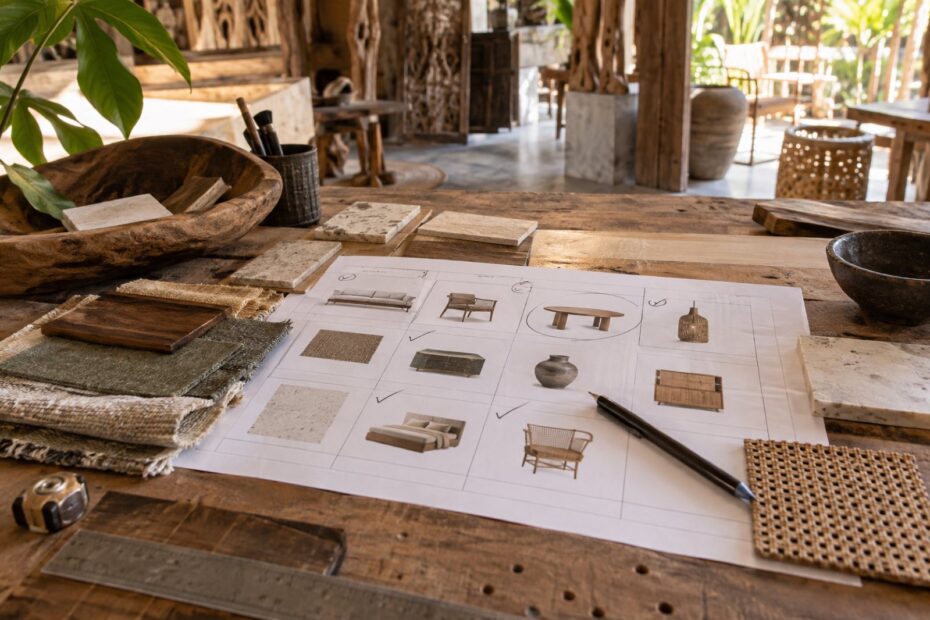
Almost every FF&E programme we have seen slip in Bali slipped in the same place. Not in production. In the four quiet weeks before production, while a finish sample sat on somebody’s desk waiting for a decision.
Production time is predictable. We can tell you within a few days how long a dining set takes. Decision time is not, and it is where entire opening dates are lost. So here is an honest timeline for furnishing a villa or a small hotel here, worked backwards from the date you want to open the doors.
The phases, and how long they really take
| Phase | Typical duration | Who holds it | What stalls it |
|---|---|---|---|
| 1. Brief and budget | 1–3 weeks | Client and designer | Budget not agreed, scope still moving |
| 2. Schedule and specification | 2–4 weeks | Designer | Incomplete drawings, no room-by-room quantities |
| 3. Quotation and award | 1–2 weeks | Supplier, then client | Value engineering rounds, late supplier comparison |
| 4. Sampling and finish approval | 2–4 weeks | Client | Samples posted overseas, approvals sitting unanswered |
| 5. Prototype / first-off approval | 2–3 weeks | Supplier, then client | Prototype requested for too many items at once |
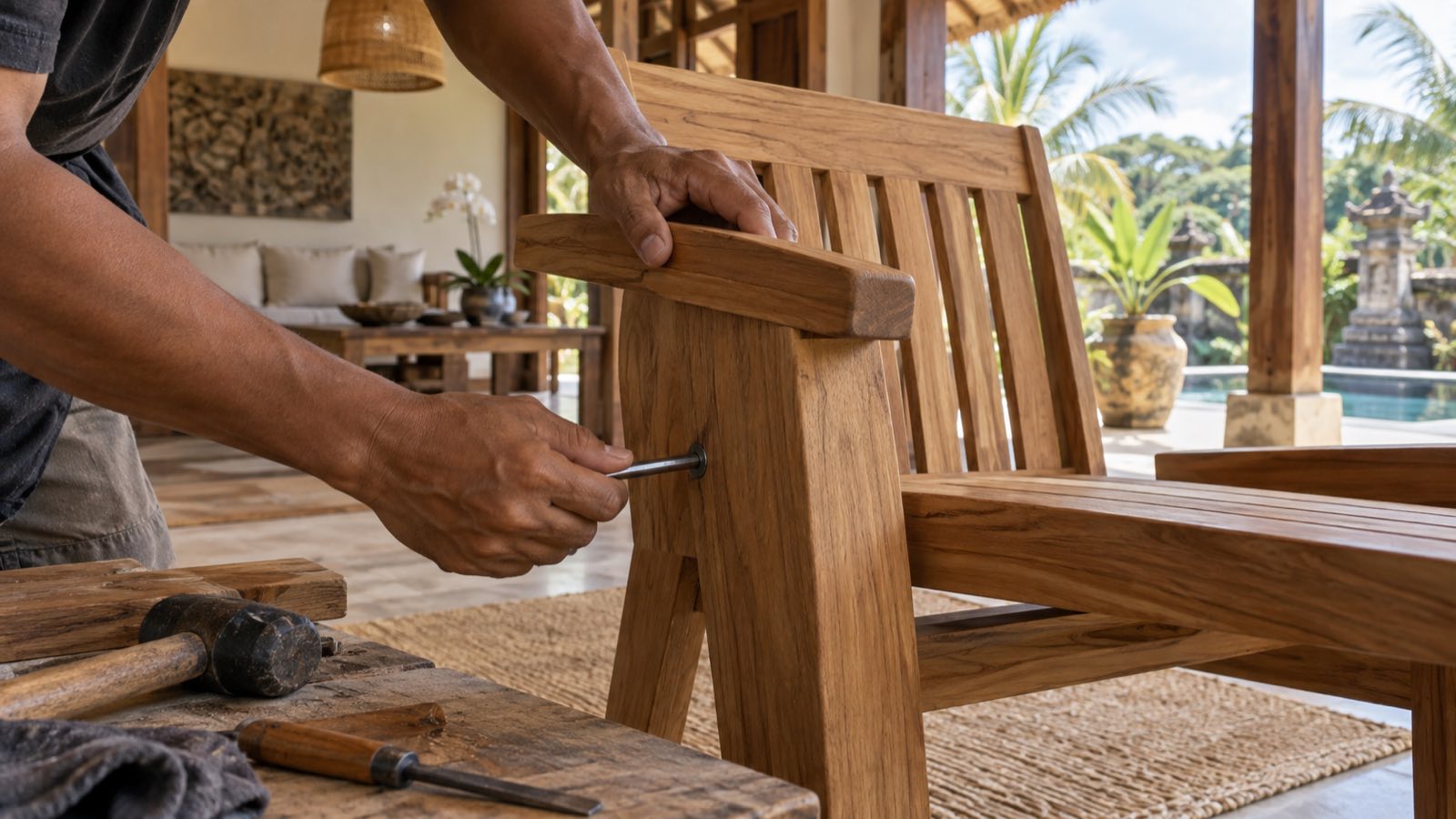
| 6. Production | 4–8 weeks typical custom | Supplier | Fabric not arrived, mid-production changes |
| 7. QC and pre-delivery inspection | 1 week | Supplier and designer | Inspection scheduled late, no snag list format agreed |
| 8. Crating and export (if shipping) | 60–90 days door to door | Freight agent | Documentation, sailing schedules, destination customs |
| 9. Delivery and site installation | 1–2 weeks | Supplier and main contractor | Site not ready, no access, no lift, wet floors |
| 10. Snagging and handover | 1–2 weeks | All | Snags raised piecemeal instead of in one list |
For a Bali project delivered locally, allow 16 to 24 weeks from signed brief to handover. For a project involving imported components or an export container, allow seven to nine months. Those are working numbers, not worst cases.
Working backwards from the opening date
Take your opening date and count back. If you are opening a twelve-key boutique hotel on 1 December, your specification needs to be locked around late June, finishes approved by mid-July, and production released no later than mid-September. Anyone telling you a full hotel schedule can be specified, sampled, prototyped and produced in eight weeks is either not doing the sampling or not doing the prototyping.
Two dates matter more than any other. Finish approval gates production. Fabric arrival gates upholstery, which is almost always the last thing to be finished and the first thing photographed.
The delays that actually happen in Bali
Generic project advice will not warn you about these. They are the ones we see every year.
Finish approvals sitting with the client. The single largest cause of slippage. A sample board goes out, the client is travelling, and three weeks vanish. Nothing can be cut in the meantime, because a stain choice can change the timber selection.
Nyepi. The Balinese Day of Silence, in March, shuts the entire island for 24 hours, including the airport and all road transport. The days either side are also affected by ceremony preparation. Plan no deliveries or installation in that window.
Galungan and Kuningan. Balinese ceremonial days on the 210-day Pawukon calendar, so the dates shift each year. Workshops run reduced crews for several days around them.
Idul Fitri and mudik. Many workshop staff across Indonesia travel home for a week or more around Idul Fitri. Expect production capacity across the island to drop noticeably for roughly one to two weeks, and expect freight and trucking to be congested before it.
Rainy season transport. Roughly November to March. Open trucks and unpaved site access do not mix with daily rain. Timber deliveries and site installation both take longer, and finishing takes longer to cure.
Upholstery fabric ordered late. Imported fabric is the classic hidden critical path. If a fabric is coming from Europe, it can take as long as the furniture does. Order fabric at specification stage, not at production stage.
Site not ready. Wet screed, no doors, no lockable store, no power for tools, painters still working. Furniture delivered into an unfinished site gets damaged, and then you are repairing new furniture.
How to compress the timeline safely
Every programme has a moment where somebody asks whether it can be done faster. Usually yes, but only in specific ways.
- Order the long-lead items first. Fabric, stone tops, imported hardware and any lighting. These do not wait for the rest of the schedule to be finalised.
- Approve finishes on physical samples early, in person if possible. Photographs of stain colours are unreliable, and a re-approval round costs two weeks.
- Prototype selectively. Prototype the pieces with genuine risk: the dining chair everyone will sit in, the bed, anything with an unusual joint. Do not prototype a simple side table.
- Release production in batches by area. Front of house and guest room one first, back of house last. This gets photography and soft opening covered even if the tail slips.
- Nominate one decision-maker. One person who can approve a finish without a committee. This alone often saves three weeks.
- Book capacity ahead of award. Workshops here are booked out in peak months. Reserving a production slot while the specification is being finalised costs nothing and protects the date.
- Agree the snag list format up front. One numbered list with photographs, one round, one sign-off.
What you should not compress: drying time, finish curing, and QC. Those three are where the shortcuts turn into warranty claims six months later.
Red flags that your project is slipping
Watch for these. Each one is recoverable if you catch it in the week it appears, and expensive if you catch it in month three.
- Finish samples have been with the client for more than ten working days.
- The upholstery fabric has not been ordered by the time production is released.
- No prototype or first-off has been signed off, but the workshop says production has started.
- The supplier has stopped sending weekly progress photographs without being asked.
- Drawings are still being revised after cutting has begun. Changes after cutting cost money and time, always.
- The main contractor cannot give you a date for a lockable, dry, powered room on site.
- Your delivery window sits on top of Nyepi, Idul Fitri or the peak of the wet season and nobody has mentioned it.
- Quantities in the schedule and quantities in the quotation do not match, and nobody has reconciled them.
What we need from you to start
If you are planning a villa, hotel or beach club and want a realistic date rather than an optimistic one, send us the FF&E schedule, the drawings, the quantities and your target opening date. We will come back with a phase-by-phase programme, a quotation and the honest constraints, including any ceremonial or seasonal dates that fall in your window.
We build to order in our Celuk workshop, typical custom lead time is four to eight weeks, and container export runs 60 to 90 days from the Port of Benoa. The gallery is open by appointment. See custom made furniture for a villa project and past projects, or message us on WhatsApp at +62 812-3842-178 and we will reply within 48 hours.