
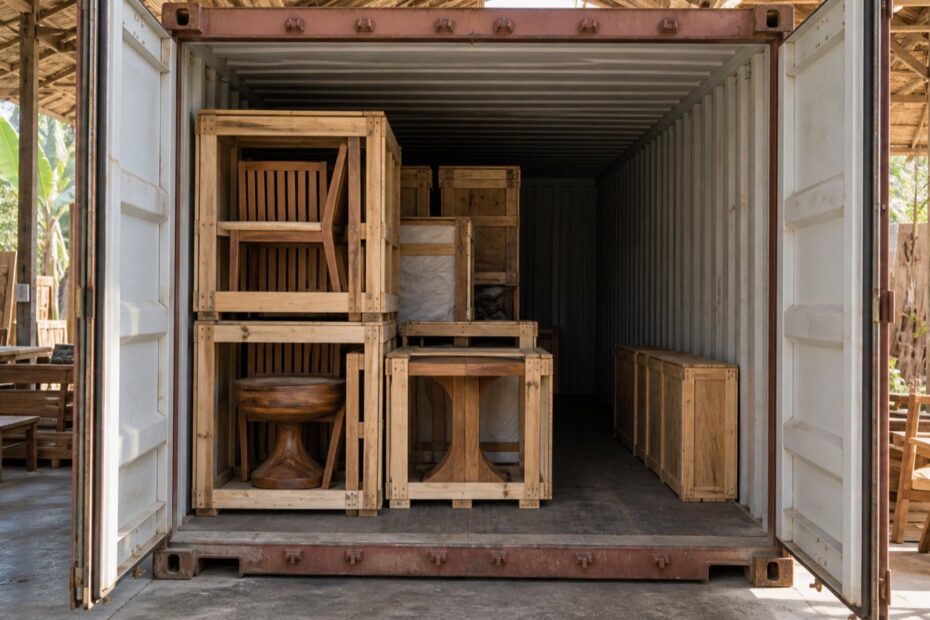
Almost every wholesale enquiry we receive opens the same way. “We’d like to order a container. How much furniture actually fits?”
It deserves a better answer than the one most exporters give, which is a number copied off a shipping line’s website. A container of dining tables and a container of carved side stools hold very different quantities of furniture and very different amounts of money. But there are reliable planning figures, and one rule sits underneath all of them: furniture cubes out long before it weighs out.
Here is how we work it out when we quote a load leaving Bali.
The three container sizes and what each one really holds
| Container | Internal length | Planning volume | Payload limit | Best suited to |
|---|---|---|---|---|
| 20ft standard | approx. 5.9 m (19 ft 4 in) | approx. 33 m³ | approx. 26–28 t | First orders, test ranges, tighter cashflow |
| 40ft standard | approx. 12.0 m (39 ft 5 in) | approx. 67 m³ | approx. 26–28 t | Established buyers, broad mixed ranges |
| 40ft high cube | approx. 12.0 m, roughly 30 cm taller | approx. 76 m³ | approx. 26–28 t | Tall cabinets, wardrobes, bulky decor |
Those figures are what we plan against. They are not what you should expect to fill, and the gap is where first-time buyers get caught out.
Why furniture cubes out before it weighs out
Solid wood furniture is mostly air. A dining chair is a few kilos of teak arranged around a large empty volume. A wardrobe is a box with thin walls. Even packed tightly, the timber itself usually occupies less than a third of the space inside the container.
Run the arithmetic. Air-dried teak sits at roughly 650 kg per cubic metre. If actual timber fills a third of a full 20ft, that is around 11 m³ of wood, somewhere near seven tonnes, against a payload allowance of roughly 26 to 28 tonnes. A full 40ft of mixed furniture commonly leaves Benoa somewhere between 12 and 18 tonnes. You run out of space long before you run out of weight.
Two exceptions. Thick suar slab tables, ironwood and anything with a stone component are dense enough to change the sum, and a container loaded heavily with those can approach its weight limit. And your destination’s road weight limits are often stricter than the container’s, so a legally loaded box at the port can be an illegal truck at the other end. Ask your forwarder before planning a heavy load.
Usable volume is not the same as container volume
Four things eat the difference between the 33 m³ on paper and what you can actually load.
Crating and packaging. Export furniture leaves Bali wrapped, corner-protected and often crated. A crate adds three to eight centimetres on every face, which sounds trivial until you multiply it across two hundred pieces.
Shape. Containers are rectangles. Furniture is not. A round 1.6 m dining table wastes the corners of its own footprint however carefully it is stacked.
Load-bearing limits. You cannot stack a wardrobe on a wrapped dining table without risking both. Some pieces sterilise the space above them, and that space is still volume you paid for.
Access and bracing. The last half metre by the doors always loads badly, and we leave room to lash and brace so nothing shifts at sea.
Expect to lose 10 to 15% of nominal volume to packing air on a well planned load, and more on a load full of awkward one-off shapes. Plan on roughly 28 to 29 m³ in a 20ft and 58 to 61 m³ in a 40ft, and treat anything better as a bonus.
A realistic 20ft load
Indicative only, because everything depends on your mix, but this is the shape of a sensible first container:
- 8 dining tables, 2 m, tops crated flat with legs bundled (approx. 5 m³)
- 40 dining chairs, stacked (approx. 7 m³)
- 5 sideboards or cabinets, shipped assembled (approx. 7 m³)
- 3 bed frames, knocked down (approx. 2.5 m³)
- 10 coffee and side tables (approx. 3.5 m³)
- 20 stools and small benches (approx. 2 m³)
- 2 pallets of decor: mirrors, carved panels, baskets, trays (approx. 2 m³)
That is about 29 m³ of packed volume against a nominal 33 m³, and it will leave Benoa at well under half the permitted weight.
A realistic 40ft load
- 16 dining tables (approx. 10 m³)
- 90 dining chairs (approx. 15.5 m³)
- 12 sideboards, cabinets or consoles (approx. 16 m³)
- 6 bed frames, knocked down (approx. 5 m³)
- 20 coffee and side tables (approx. 7 m³)
- 40 stools and benches (approx. 4 m³)
- 4 pallets of decor and textiles (approx. 4 m³)
Roughly 61 m³ against a nominal 67 m³. A 40ft does not hold exactly twice a 20ft in practice. It usually holds a little more, because a longer box gives the loading team more freedom to pair tall items with short ones.
Knock-down construction nearly doubles what you ship
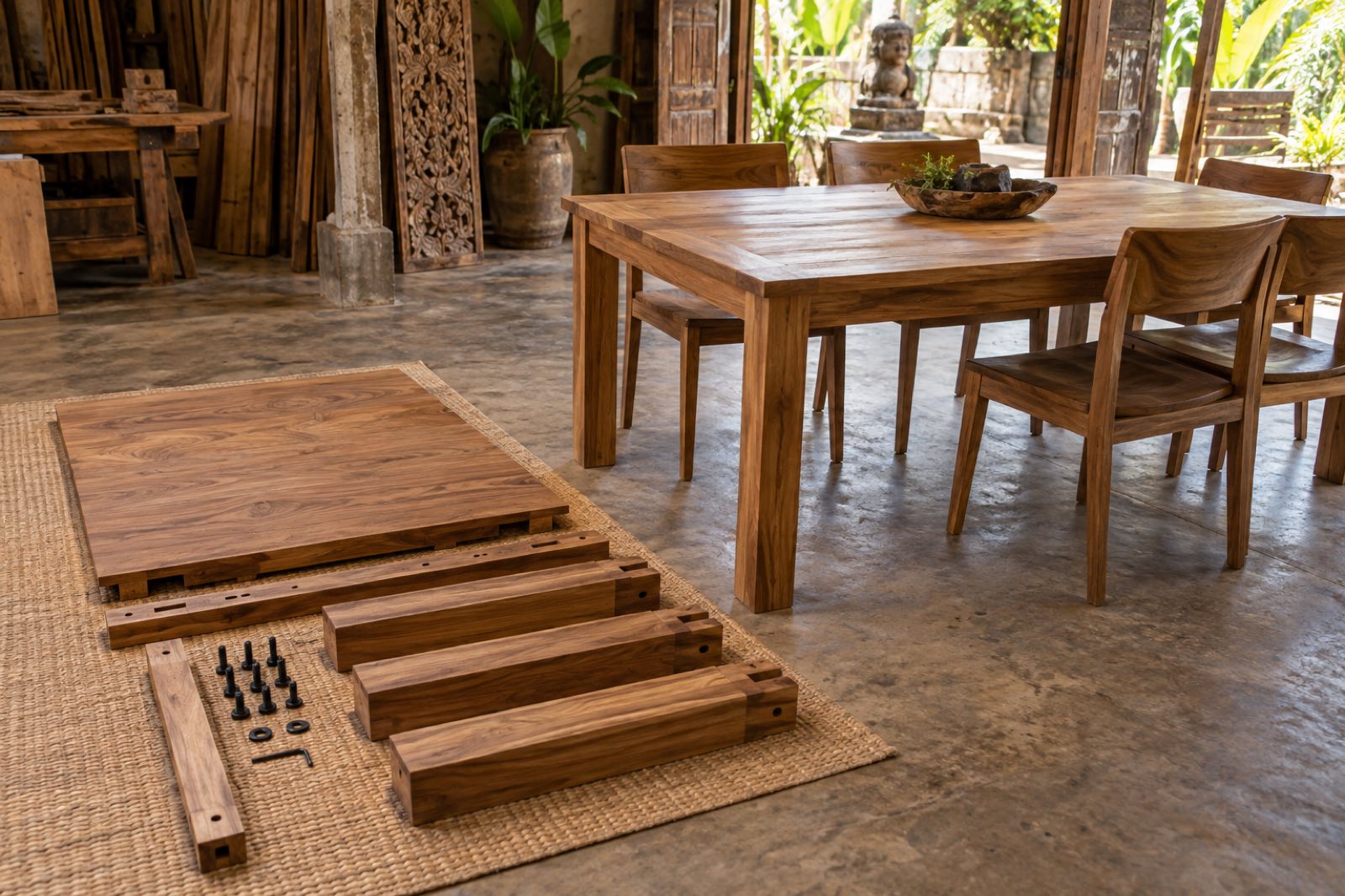
A 2 m teak dining table shipped assembled takes close to 1.6 m³ once wrapped, and you cannot safely stack much on top of it. The same table with the top crated flat and the legs and stretchers bundled alongside occupies around 0.5 m³. That is the single biggest lever you have on freight cost per unit.
Not everything can be knocked down. A carved cabinet, an antique, a live-edge suar slab and most case goods travel as they are. But across a normal mixed range, specifying knock-down wherever the design allows will get close to twice as much furniture into the same box. Raise it at the quotation stage, not after drawings are approved, and agree in writing that fittings are bagged and labelled per item and that assembly instructions travel inside the crate. Knock-down saves freight and spends warehouse hours at your end.
When a 40ft high cube earns its extra cost
A high cube gives you around 9 m³ more than a standard 40ft, usually for a modest freight premium. It pays when your range is tall: wardrobes, bookcases, headboards, large mirrors, rattan and basketry. It pays much less when your range is low and flat, because you cannot use height you cannot safely stack into. Before booking one, check the door height at your own warehouse and whether high cubes are restricted on your road route inland.
LCL and groupage for a first small order
Our export and wholesale division works to a minimum of one 20ft or 40ft container, shipped FOB or CIF through the Port of Benoa. If your first order is genuinely smaller, you have two routes. The gallery side has no minimum order and arranges crating and freight for individual pieces worldwide. Or you can ship LCL, sometimes called groupage, where your pallets share a container with other shippers’ cargo.
LCL costs more per cubic metre, adds a consolidation warehouse at both ends, adds handling and therefore damage risk, and typically adds a week or two to transit. For a genuine 8 to 12 m³ trial range it still beats guessing at a full container.
Build a container that sells, not a container that fills
The most expensive mistake we see is a buyer ordering 200 of one item because the unit price drops, then spending two years selling the tail. A container that sells usually looks like this:
- Two or three hero pieces. Large, photogenic, high margin. They sell the room and carry your marketing.
- A working core. The dining tables, chairs, sideboards and beds that turn over predictably.
- Accessories and decor. Stools, mirrors, trays, textiles. They fill the gaps between big items, cost little to freight and often carry your best percentage margin.
- Five to ten per cent left unallocated until the final packing list, so we can fill genuine gaps rather than force them.
Two more things belong on the purchase order. Keep finishes coherent across the load so pieces photograph as a range, and specify the moisture content for your market. Furniture acclimatised for tropical Bali and shipped into a heated European interior is the most common cause of cracking after import. Our notes on teak and suar explain how each behaves.
Ready to price a load?
Send us your product list with target quantities, or simply your budget and the categories you sell, and we will come back with a packing plan and a cubic metre estimate before you commit. Plan 60 to 90 days from confirmed order to departure from Benoa. Message us on WhatsApp at +62 812-3842-178, or read more about our export and wholesale services. We reply within 48 hours.