
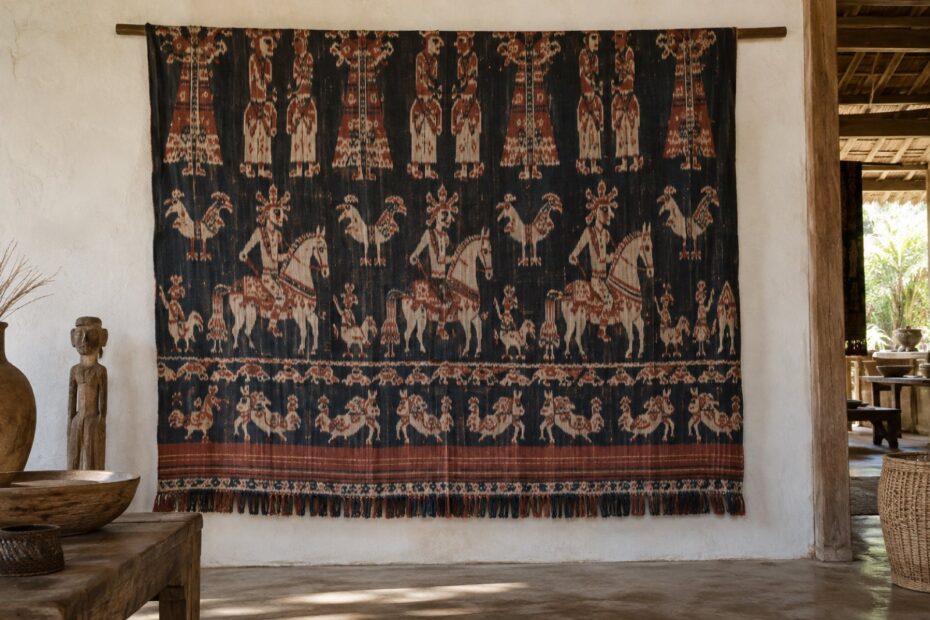
Kaliuda is a village in East Sumba long known for its ikat weaving, and the cloths that come out of that part of the island are some of the finest textiles made anywhere in Indonesia. We get asked about these cloths constantly, and almost always the same question: I have one, or I am about to buy one, what do I actually do with it?
The history behind the weaving is a separate subject, and we have written it up already in The Tradition of the Sumbanese Ikat and Its Culture. This article is about the practical half. How to put a textile in a modern room without it looking like a souvenir, and how to keep it alive for the next fifty years in a climate that is actively trying to eat it.
Eight ways to bring a textile into a room
Scale is the thing people get wrong. A full Sumba hinggi is a large cloth, often well over two metres long. Treated as a small accent it looks lost, and cut down it loses most of its value. Work with the size you have.
1. Framed and floated behind glass. The best option for a fragile, old or valuable piece. The textile is stitched to a fabric-covered backing board and floated so the edges and fringe stay visible, then glazed with UV-filtering acrylic or glass. It protects against dust, insects and light, and it forces you to hang it flat. Expect it to be the most expensive option, and expect a large frame. Best on a wall where it can be seen from three or four metres back.
2. Hung from a timber batten. The classic gallery method and the one we use most. A slim wooden batten is sewn into a fabric sleeve at the top of the cloth, or the cloth is hung over a rounded rod, spreading the weight along the entire top edge. It suits a full-length hinggi on a plain wall, it costs very little, and it lets you take the piece down easily for rotation. Keep the batten a shade narrower than the cloth so it disappears.
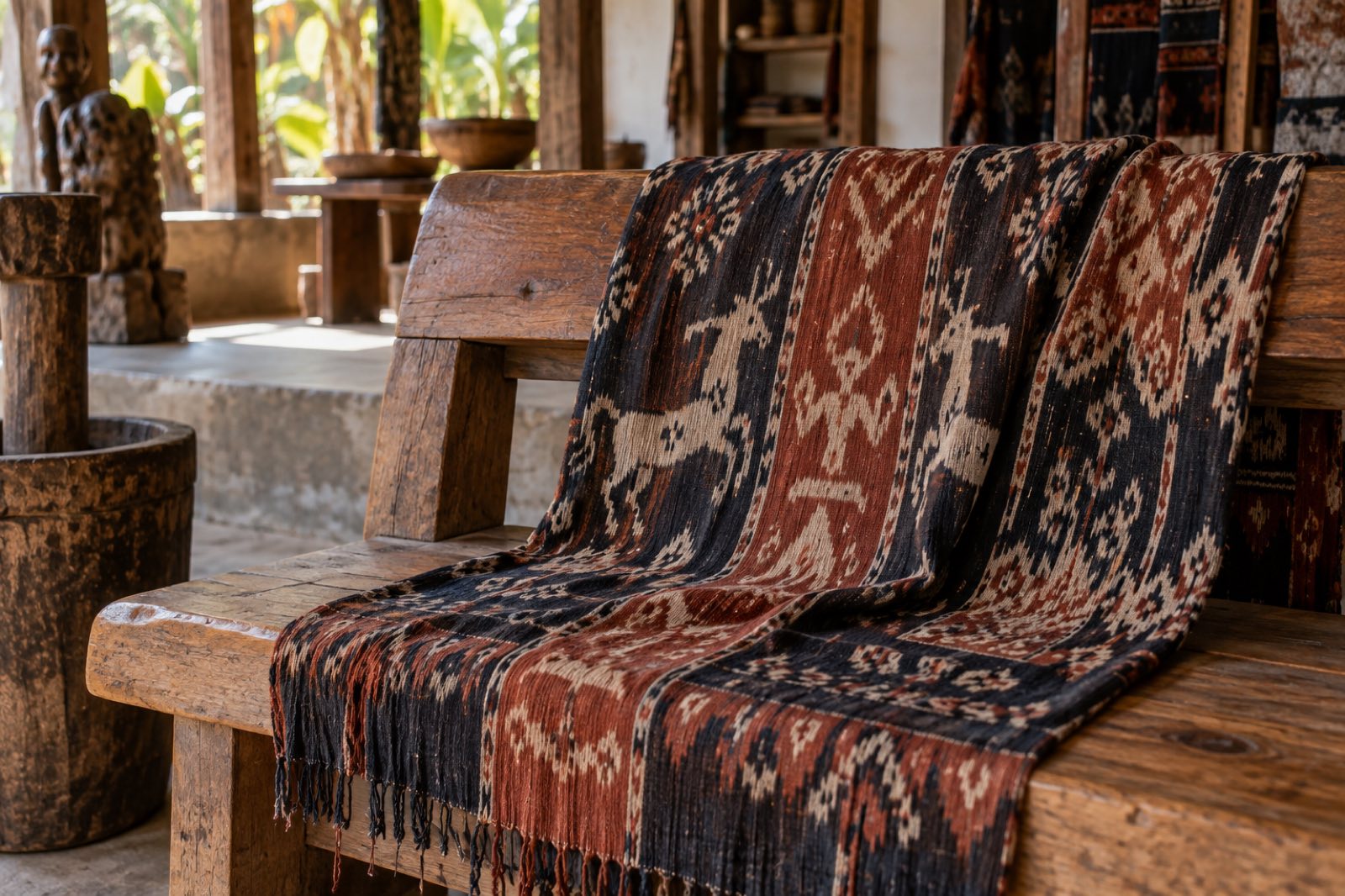
3. Over the back of a bench or a low chair. Folded once, lengthwise, over a timber bench back or a chair. This works because the textile reads as an object in use rather than an exhibit. Good in an entry hall or at the end of a corridor. Keep it off any surface people sit on with sunscreen or insect repellent on their skin.
4. As a bed runner. Folded to about a third of the bed width and laid across the foot. Easily the most common use, and the one most likely to cause damage, because runners get sat on, slept on and dragged. Use a sturdier piece here, not your best one, and take it off the bed at night.
5. As a cushion facing. A strong pattern needs air around it, so one or two ikat-faced cushions on a plain sofa, not six. Face one side only and use plain heavy cotton or linen on the back so the cushion can be turned when guests arrive. Ask for a removable cover with a hidden zip rather than a sewn-in pad, and never put a fragile antique fragment on a seat cushion.
6. As a dining table runner. Visually excellent, practically risky. Wine, oil, candle wax and hot dishes all end up on a table runner. If you do it, use a robust newer weave, keep it under the centreline of the table rather than the place settings, and accept that it is a piece you will wash.
7. Layered on a neutral sofa. Draped diagonally across one arm and the seat, with the fold deliberate rather than tossed. This is the softest way to introduce pattern into a room built around a plain wooden sofa or a linen upholstered one. The trick is a single generous fold, not several small ones.
8. As the only colour in a monochrome room. The most powerful use of all. A room in off-whites, greys and natural timber, one deep indigo and rust hinggi on the largest bare wall, and nothing else competing. Everything the textile does, from the depth of the dye to the irregularity of the hand-tied resist, becomes visible because there is nothing else asking for attention.
Caring for Indonesian textiles, especially in the tropics
Most styling articles stop before this part. It is the part that decides whether you still have the piece in twenty years.
Light is the damage you cannot reverse
Direct sunlight fades natural dyes and, worse, breaks down the cotton fibres themselves. A faded textile can at least be looked at. An embrittled one falls apart at the folds. Never hang a textile on a wall that gets direct sun at any hour, and be careful with the low, raking light that comes in under an overhang late in the afternoon. Indirect daylight is fine. If the piece is important, UV-filtering glazing and a dimmer corner are worth the compromise.
Humidity and mould
In Bali we live at high humidity for months at a time, and mould will colonise a textile that never gets air movement behind it. Two habits prevent almost all of it. First, never hang a cloth flat against a cold or damp wall; leave a few millimetres of air gap behind it. Second, run a fan or open the room regularly. If you store a textile, use a breathable cotton bag or acid-free tissue, roll it rather than folding it, and store it flat or rolled on a tube. Sealed plastic is the worst choice: it traps moisture against the fibres.
Insects
Silverfish, carpet beetle and moth all find handwoven cotton attractive, particularly where there are food or body oils on the cloth. Inspect the reverse and the folds every few months, keep stored pieces away from timber that is already infested, and use cedar or dried cloves rather than naphthalene mothballs, which leave a smell in the fibres for years.
Hanging without stressing the fibres
The rule is simple: spread the load along the whole top edge. Never hang a textile from two nails, two clips, or a corner. Each point takes the whole weight of the cloth and, over months, tears it. A sewn sleeve and batten, or a full-width strip of hook-and-loop tape stitched to a fabric tape (never glued to the textile), both work. Then turn the piece end for end every year or so, so the same edge is not always carrying the weight.
Cleaning, or rather how not to
Do not machine wash, dry clean, bleach or steam an old or natural-dye textile. Natural dyes are not colourfast in the way commercial dyes are, and indigo in particular will bleed. For routine care, vacuum gently through a piece of fine mesh or nylon screen with the suction low, always in one direction. Air the piece in the shade. For a stain or anything genuinely soiled, stop and speak to a textile conservator. A modern, commercially dyed piece used as a runner or cushion cover is a different matter and can be hand washed cold, but test a corner first and never wring it.
Rotate
If you own several pieces, hang one at a time and swap them every six to twelve months. Rested textiles last longer, and the room stays interesting.
What to look for when buying
Without making claims about any particular piece, there are honest signals you can check yourself.
- Look at the back. On a genuine handwoven ikat, the pattern is created in the yarn before weaving, so it appears on both faces with similar strength. A printed cloth is bold on the front and pale on the back.
- Look for the softness of the pattern edges. Ikat outlines have a slight feathering where the tied resist let dye creep. Perfectly crisp edges usually mean print.
- Look for irregularity. Small variations in width, in the density of the weave, in the repeat. Machine consistency is a tell.
- Ask about the dyes. Natural indigo, morinda root and other plant dyes have depth and slight unevenness, and the seller should be able to tell you what was used and roughly when the piece was made.
- Check the condition honestly. Old holes, weak folds and previous repairs are normal and not automatically a problem. They should be reflected in the price and disclosed.
We keep Sumba textiles, Indonesian antiques and primitive art alongside the furniture, and pieces come and go, so what is in the gallery this month may not be here next month. If you are specifying for a project and want to see what is currently available, or you want a bench, batten or frame made to suit a cloth you already own, come and see us by appointment in Celuk, Sukawati, or message WhatsApp +62 812-3842-178. Designers are welcome to send drawings and we will build to them.