
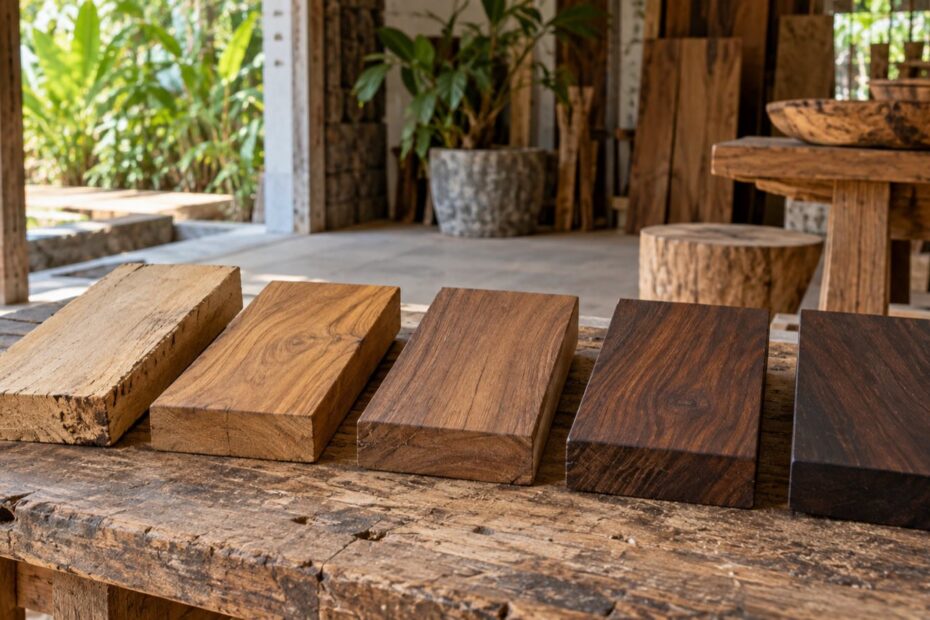
Most people choose a finish from a photograph. They see a table on a screen, like the colour, and assume the colour is the product. It isn’t. The finish decides how that piece ages, how it copes with a wet season, whether a scratch is rubbed out in ten minutes or needs a full re-sand, and, yes, how it photographs.
We finish furniture every working day and get the same three questions. Which one is toughest? Which one looks like the picture? Which one can I fix myself? Here is the long answer.
Two families, and then everything else
Every finish we use belongs to one of two families.
Penetrating finishes soak into the timber and sit below the surface. Oils and waxes. There is no film, so nothing can chip or peel, and you are touching wood. They need renewing.
Film-forming finishes cure into a thin skin on top. Polyurethane and lacquer. They protect far better against water, heat and stains, but when they fail they fail visibly, and the repair is a bigger job than a wipe with a cloth.
Nearly everything else on a colour chart is one of those two with pigment or glaze added.
Natural oil (penetrating oil)
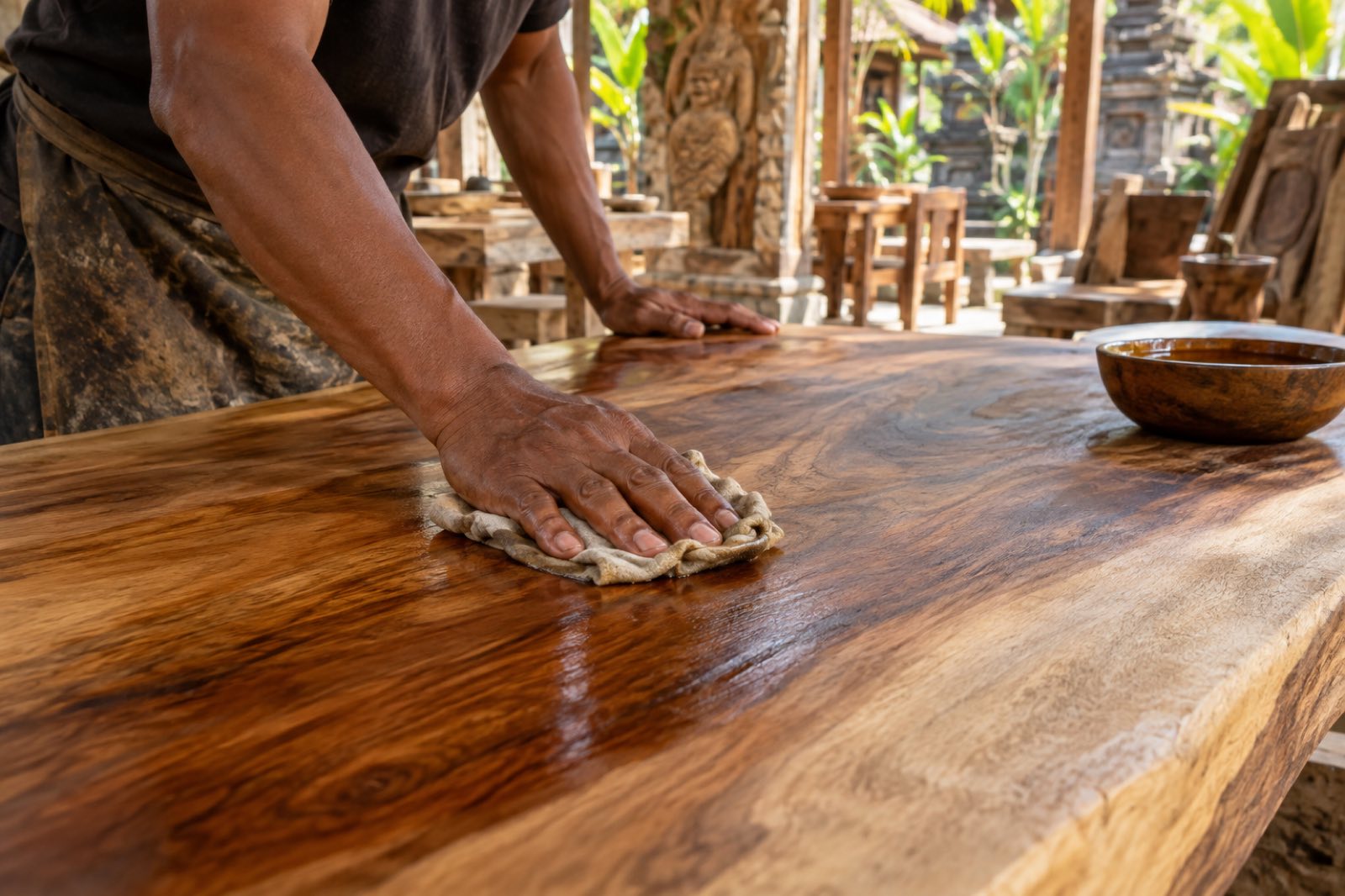
Looks like: deeper, warmer grain, as though the board has been rained on and dried. Low sheen, and it feels like timber rather than plastic. On teak it lifts the honey tones.
In humidity: excellent. The wood keeps exchanging moisture with the air, nothing is sealed in, and there is no film to cloud or lift.
Indoors and out: both. Indoors it is close to maintenance-free. Outdoors, under tropical sun and rain, it is a commitment.
Repairs: the best of any finish. Scuff the mark with fine abrasive paper, wipe on more oil, feather it out. No line where the repair starts and stops, and housekeeping staff learn it in five minutes.
Refresh: every 12 to 24 months indoors, more often on a dining table wiped daily. Outdoors, every three to six months to hold the colour.
The catch: oil is not a stain barrier. A wet glass left overnight leaves a ring, and red wine on an oiled table is a real event.
Wax
Wax normally goes over oil rather than instead of it. It adds a soft, slightly buttery sheen and a lovely hand feel, and almost no protection. Water marks it, heat softens it, and repairs are trivial: more wax, more buffing. Redo it every six to twelve months.
Wax belongs on decorative pieces, cabinets and carved work, not on a dining table, a bathroom vanity, or anything a hotel guest will use.
Matte and satin polyurethane
The workhorse for hospitality and family homes. A cured PU film resists water, heat, alcohol and daily wiping far better than any oil. Matte reads modern and quiet, satin has a slight lift and hides fingerprints better, and full gloss rarely flatters solid wood.
In humidity: a good barrier in both directions, which is why the timber underneath must be dry before it goes on. Coat wood that is too wet and you seal the moisture in, and months later you get blistering or milky patches. Ask any supplier how they dry timber before finishing.
Repairs: the honest weakness. You cannot spot-repair a scratch in a PU film invisibly. The fix is to sand back and recoat the whole surface, which for a table top means it leaves the house.
Refresh: five to ten years indoors, less on a busy restaurant table.
Not for sun and rain. UV degrades the film, water gets under the edge, and it flakes. Outdoors, use oil.
Water-based lacquer
Water-based coatings dry quickly, smell far less in the workshop, and stay clear instead of ambering with age the way some solvent-based products do. If you have specified a pale or whitewashed colour, this is usually what keeps it pale rather than letting it drift yellow after three years. Abrasion resistance sits a little below a two-pack PU, and repairs behave the same way: local touch-ups show, whole surfaces don’t.
White wash and grey wash
A wash is a colour treatment, not a protective coat. Pigment is thinned so it settles into the grain and leaves the figure readable, then the piece is sealed, usually with a matte lacquer or PU.
Washes suit open-grained timber, where the pigment has somewhere to sit, and they carry a lot of villa projects here. Two things to know. Sun fades a wash faster than a clear finish, so keep washed pieces off the terrace. And colour matching a wash later is done by eye, so we keep an offcut from the same batch with the job. Ask your supplier to do the same.
Antique and distressed
Antique is a process, not a coat: the surface is knocked back and distressed, a dark glaze worked into the grain, corners and carving, then sealed. It arrives already aged, so the next ten years of knocks read as character rather than damage.
Plan for repeatability. Two antique pieces finished by two hands on two days will differ slightly, which is charm on one piece and a real problem across twelve chairs. An approved sample matters more here than on any other finish.
Raw and unfinished
Sanded, and nothing else. Two good reasons: a designer wants to apply a finish on site, or the piece is teak destined for full exposure and the client wants it to weather to the silver-grey patina teak is famous for. That patina is a surface effect, not decay.
One warning. Raw timber absorbs dirt, hand oils and building dust, so do not have it delivered into a site still under construction.
Finish comparison at a glance
| Finish | Look and feel | In humidity | Outdoors? | Scratch repair | Refresh |
|---|---|---|---|---|---|
| Natural oil | Warm, deep grain, no sheen | Excellent, wood breathes | Yes, with upkeep | Spot repair, invisible | 12–24 months |
| Wax over oil | Soft sheen, silky | Good, little barrier | No | Very easy | 6–12 months |
| Matte / satin PU | Even, contemporary | Good barrier if timber dry | No | Whole surface recoat | 5–10 years |
| Water-based lacquer | Clear, stays pale | Good barrier | No | Whole surface recoat | 5–10 years |
| White / grey wash | Pigment in the grain | Depends on the sealer | Not advised, fades | Touch in and reseal | With the sealer |
| Antique / distressed | Aged, glazed, uneven | Depends on the sealer | Covered areas only | Hides damage well | Rarely |
| Raw / unfinished | Pale, dry, matt | Moves with the air | Yes, will silver | Sand only | Client decides |
How to choose, in four questions
- Where will it live? Air-conditioned interior, open-air tropical living room, covered terrace, or full sun and rain. These are four different answers, not one.
- What will happen on it? Hot plates, wet glasses, laptops, children, paying guests. The more of those, the stronger the argument for a film finish.
- Who maintains it? An owner who enjoys oiling a table once a year is a different client from a hotel with a housekeeping rota and no wood knowledge.
- Do you want it to look like wood, or like a surface? There is no wrong answer, but answer it honestly before you look at photographs again.
The same finish looks different on teak, suar and mahogany
This surprises people more than anything else here. The finish is half the result, the timber is the other half.
Teak carries its own oil and a high silica content, which is why it takes a penetrating oil so well and needs careful preparation under some water-based products. It reads golden and gets richer with age. More in All About Teak Wood.
Suar has wide boards, open grain and dramatic contrast between pale sapwood and dark heartwood. Oil deepens that contrast, and a white wash sitting in the open grain gives a far more graphic result than the same wash on teak. See All About Suar Wood.
Mahogany has a fine, even grain and a reddish base, which makes it the most predictable of the three for a uniform colour. Under oil it goes noticeably warmer and redder.
So specify finish and species together, and judge them together.
Look at a real sample, not a screen
No screen is honest about wood colour. Two monitors in the same room will disagree, and every finish shifts as it cures. Our Color Chart & Material Knowledge page shows the finishes we work with and is the right place to build a shortlist. Treat it as exactly that. Before production we would rather send you a physical sample on the actual species, and for washes and antique work we keep an approved sample in the workshop for the life of the order.
Designers: send your finish schedule with your drawings and we will sample against it. Buyers in Bali: our gallery in Celuk is open by appointment, and twenty minutes handling the finishes in daylight beats a week of scrolling. Message us on WhatsApp to arrange a time, or read more on our furniture and interior services page.