
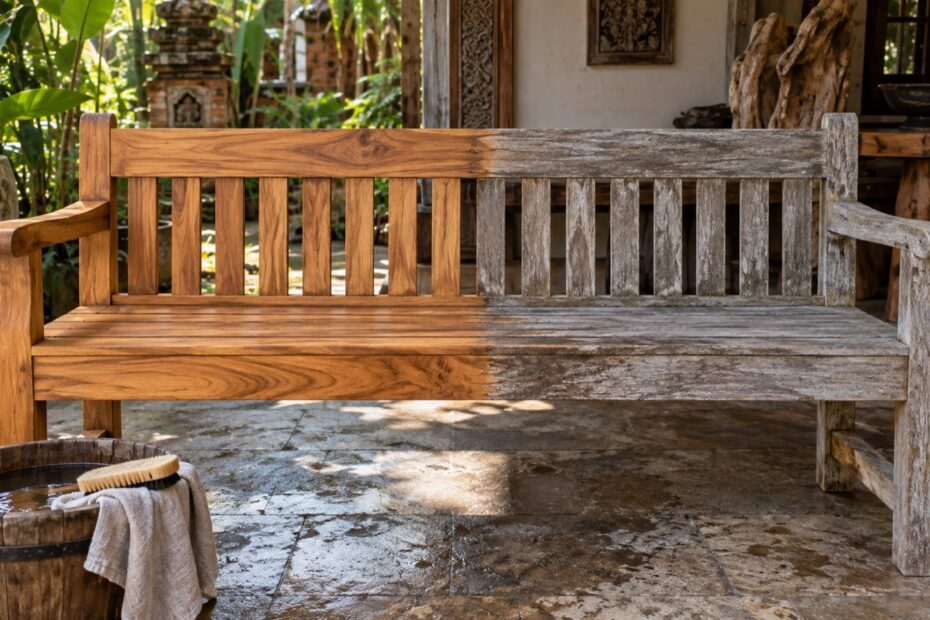
Teak is the easiest hardwood in the world to look after and the one people worry about most. It has high natural oil and silica content and class 1 durability, and it will sit outside for decades without being treated at all. Left alone outdoors it turns a soft silver-grey. That is not damage. It is the wood behaving exactly as it should.
Almost all the teak problems that reach our workshop come from too much intervention rather than too little. Pressure washers, wire brushes, silicone sprays, varnish over damp wood. The honest version of teak care is short, and the useful part is knowing when to do each job. Here is the year, as a calendar you can follow.
If you want the background on the species itself, we have covered it in All About Teak Wood.
Weekly, five minutes
Outdoors. Brush off leaves, blossom, bird droppings and pooled water. Anything organic sitting on wet timber becomes a mould colony within days, and that is the source of most black spotting. Tip chairs forward so water drains instead of sitting in the seat joints.
Indoors. Dust with a dry or barely damp cloth, along the grain. Lift objects rather than sliding them. Use coasters and mats, because the two most common indoor teak repairs we see are white water rings and heat marks from a hot dish.
Monthly, twenty minutes
Wash with mild soap and warm water. Dish soap is fine. Use a soft nylon brush or sponge, work along the grain, rinse and let the piece dry in shade with air moving around it. Drying in full sun drives fast surface shrinkage.
For indoor teak, check the underside and back for early mould, and wipe down legs and feet where floor cleaner collects.
Never use these on teak:
- Pressure washers. They cut the soft early wood out from between the harder grain lines and leave a furry, ridged surface. Irreversible without heavy sanding.
- Bleach or chlorine on an oiled or finished surface. It bleaches unevenly and leaves the timber blotchy.
- Steel wool. Fragments stay in the grain and rust, leaving black spots. Use a nylon pad instead.
- Silicone-based furniture polish. It builds a slick film, attracts dust, and contaminates the surface so that refinishing later becomes far harder.
Quarterly, an hour
Turn everything over and look at it. Tighten bolts and screws, because timber moves with humidity and outdoor joints loosen through a wet season. Check for insect frass, the powdery dust below a small hole that signals borer activity in sapwood or in a non-teak component. Wash cushion covers and stand the foam on edge in shade for a day so it dries right through. Lift outdoor pieces off wet paving onto pads if they sit in a permanent puddle.
Indoors, this is the point to apply wax or a light oil if you use one, which brings us to the argument.
The oiling question, honestly
You will read that teak must be oiled twice a year. Outdoors, in a humid tropical climate, that advice is mostly wrong.
Teak already contains its own oil. Applying more does not protect the timber structurally and does not stop weathering. It darkens the surface for perhaps six to twelve weeks, then breaks down unevenly and leaves patches. Worse, most teak oils are organic, and in high humidity they feed mould. Much of the black spotting we are asked to fix is on furniture that was oiled diligently every few months.
So, our position:
- Outdoor teak: do not oil. Wash it and let it silver. If you cannot live with grey, plan a clean and light sand once a year rather than oil every quarter.
- Indoor teak: occasional oil, or better a hard wax, is genuinely useful. It protects against spills and hand oils, and indoors there is no mould pressure. Once or twice a year is plenty. Apply thinly, wipe off whatever has not absorbed within fifteen minutes, and buff.
- Never oil damp wood. Wait until the piece is dry all the way through, which after heavy rain means several days.
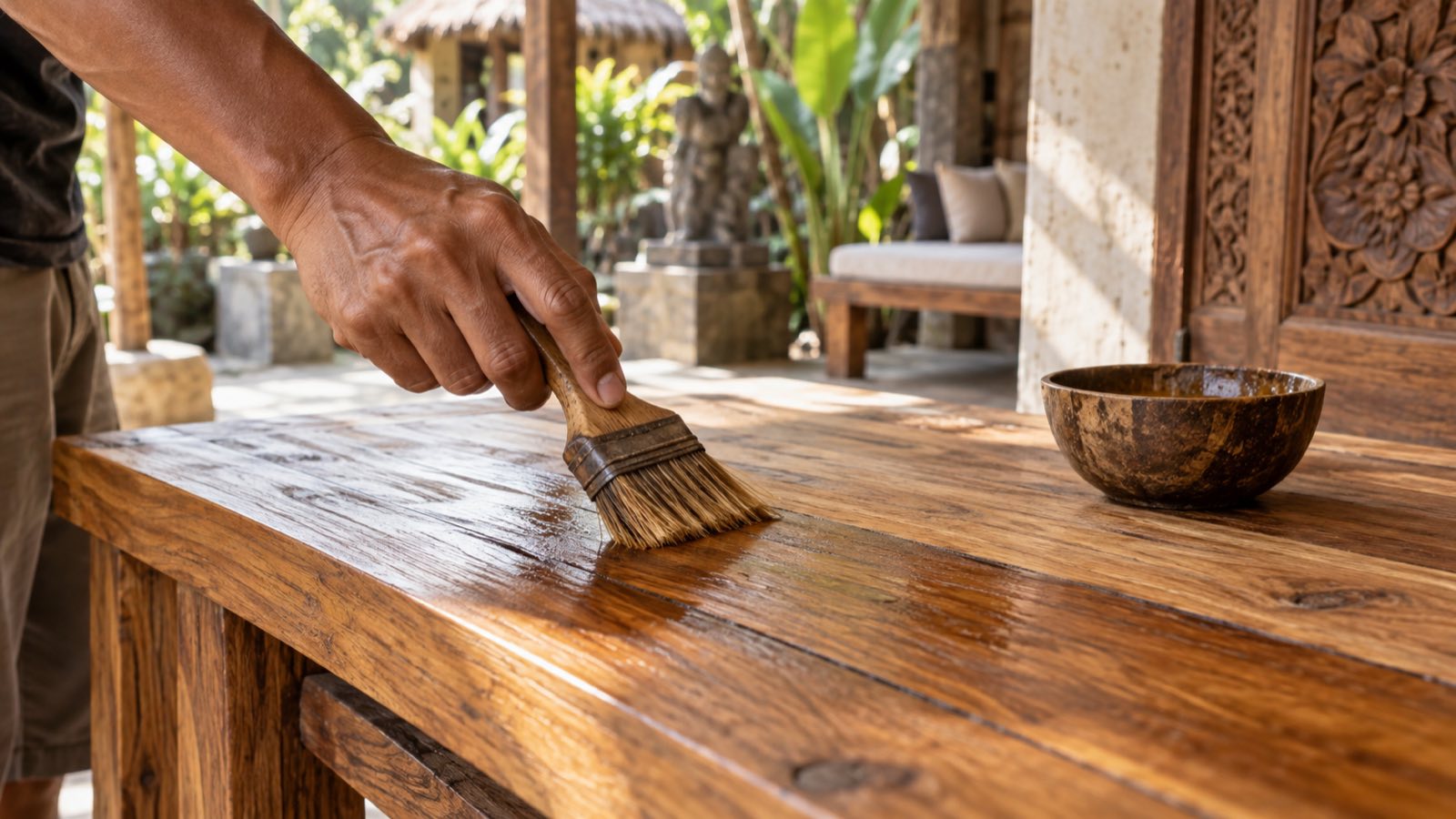
Pre-monsoon: the first big job
In Bali this is roughly late September into October. Elsewhere, do it before your wettest season.
- Wash everything thoroughly with soap and water and let it dry completely.
- Deal with any existing mould now, before it has a wet season to work with.
- Tighten every fixing, and replace any that are rusting. Stainless steel is worth the money outdoors.
- Get furniture up off the ground. Even 20 mm of clearance stops the end grain wicking water out of wet paving.
- Store or cover cushions. Cushions are the real casualty of a wet season, not the timber.
- If you cover furniture, use a breathable cover, never a sealed plastic sheet. Trapped moisture under plastic causes far more mould than open rain ever does.
Post-monsoon: the recovery job
Around March into April here. This is the annual reset.
- Wash and scrub gently, along the grain, with soap and water.
- Treat mould and mildew spotting. Dilute oxygen bleach, sodium percarbonate, in warm water is the safer option on bare teak. Leave it ten to fifteen minutes, scrub lightly along the grain, rinse thoroughly. Avoid chlorine bleach on any oiled or finished surface.
- Once dry, sand lightly only where needed, 180 to 220 grit, with the grain.
- Check joints and re-glue anything that has opened, or bring it to a workshop.
- Air the cushions properly and check foam for internal mould.
Cracks, checking, and when to worry
Fine hairline splits running with the grain on an outdoor surface are surface checking. They are caused by the top few millimetres of timber swelling and shrinking faster than the core, and they are cosmetic. Every piece of outdoor teak develops them. Leave them.
Worry when a crack runs across the grain, opens through a joint or a tenon, or when the piece flexes or creaks under load. That is structural and it needs a workshop.
The other common cause is moisture mismatch. Furniture acclimatised in Bali carries more moisture than furniture living in a dry, heated European or North American interior, and that difference, not the shipping, is the single biggest cause of cracking after import. Keep an imported piece away from radiators and underfloor heating for its first few months.
Bringing back the honey colour
Reversing the silver is a mechanical job, not a chemical one. The grey is a thin weathered layer, a fraction of a millimetre deep. Clean the piece, let it dry, then sand along the grain from 120 grit up to 180 or 220. The colour underneath comes straight back. Two-part teak cleaners do the same thing chemically but are aggressive on the soft grain and on surrounding stone and planting. Either way you are removing timber, and there is a limit to how often you can do it.
Troubleshooting
| Symptom | Likely cause | What to do |
|---|---|---|
| Black speckles on outdoor teak | Surface mould, usually on oil residue or trapped dirt | Oxygen bleach solution, gentle scrub with the grain, rinse, dry, and stop oiling |
| Even silver-grey colour | Normal UV weathering, not damage | Leave it, or clean and sand back to 180 grit if you want the honey tone |
| White ring on a dining table | Moisture trapped in the finish or wax layer | Gentle heat from a warm iron over a cloth, or re-wax the area; deeper rings need refinishing |
| Cloudy white patch after a hot dish | Heat damage to the finish | Same treatment as a water ring; if the timber itself is scorched it needs sanding |
| Sticky or blotchy surface | Over-oiling, or oil applied over a sealed finish | Wipe back with a solvent-dampened cloth, then leave uncoated |
| Fine cracks along the grain | Surface checking | Cosmetic, no action needed |
| Crack across the grain or through a joint | Structural failure or severe drying | Stop using the piece and have it assessed |
| Rust streaks or black pinpoints | Non-stainless fixings, or steel wool left in the grain | Replace with stainless, sand out the staining |
| Musty cushions | Foam holding internal moisture | Wash covers, stand foam on edge in shade for a day |
Most of these jobs are doable at home, but some are not worth your weekend. Our workshop in Celuk, Sukawati offers repair, touch-up and full refinishing for solid wood pieces, and we are happy to look at photographs before you move anything heavy. One limit, stated plainly: the service covers solid timber only. We do not refinish HPL, MDF or vinyl-wrapped furniture, because there is no solid surface underneath to work with. Details are on our services page, or message WhatsApp +62 812-3842-178.