
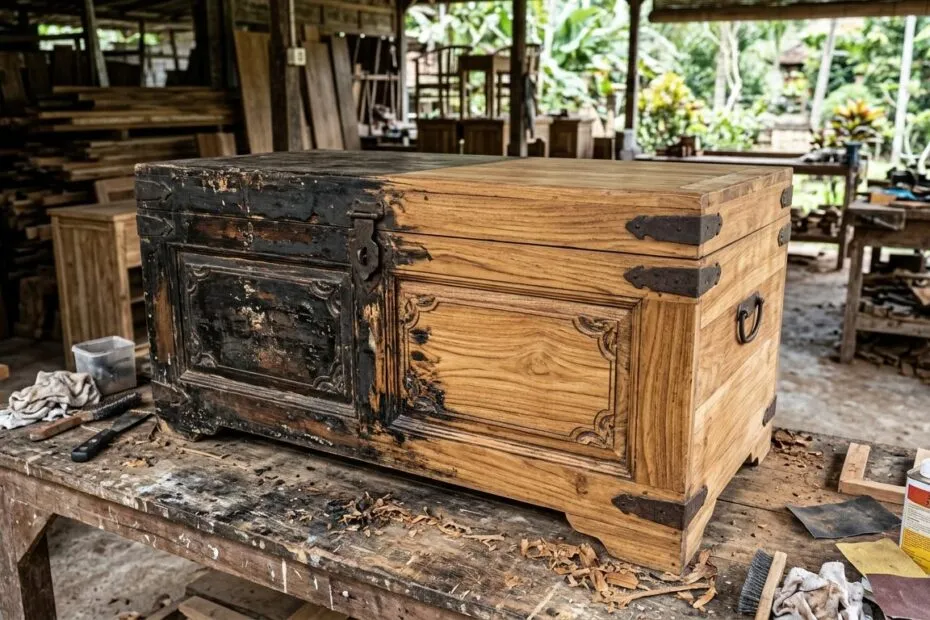
Furniture restoration in Bali covers three jobs: repairing what is broken, touching up what is worn, and refinishing what has lost its surface. We do all three in our workshop in Celuk, Sukawati, on solid wood furniture and on antiques. The aim is simple. Bring a piece back to its original condition without taking away what made it worth keeping.
This guide sets out what we can restore, what we can’t, how the work usually runs, and how to send us photos for a quote.
What restoration covers
Most requests fall into one of four kinds of work.
Repair. Loose joints, cracked rails, split tops, broken legs, missing mouldings, drawers that stick or drop. Structural work comes first, because no finish survives on a frame that moves.
Touch-up. Scratches, white rings from cups, sun-faded patches, chipped edges. The original finish stays where it is sound and only the damaged areas are worked on.
Complete refinishing. The old finish comes off, the surface is repaired and prepared, and a new finish goes on. This suits pieces where the finish has failed across the whole surface: peeling lacquer, cracked varnish, or teak that has been left outside until it turned silver.
Rejuvenation of antiques. Antiques need a lighter hand. Cleaning, consolidating loose parts and feeding a dry surface can do more for an old piece than any refinish. More on this below.
What we can and cannot restore
We restore solid wood. That includes teak, mahogany, suar and other hardwoods, and older pieces in local timbers.
We do not restore HPL (high-pressure laminate), MDF or vinyl. These are thin decorative layers on a board, or boards made of fibres and glue. Once the surface layer is chipped, swollen or peeling, there is no solid timber underneath to work back to. Replacement is usually the honest answer, and we will tell you so.
Veneer on a solid wood carcase can often be repaired. Send photos and we will tell you which you have.
Conservation or refinishing: decide before anyone sands
This is where restoration goes wrong most often.
A new teak dining table can be stripped and refinished with no loss. An antique is different. Its surface carries its age: wear on the arms of a chair, the darkened patina on a cabinet door, old paint in the recesses of a carving, hand-tool marks. Collectors and dealers read these signs. Strip them away and the piece can look brighter and be worth less.
So for antiques, our starting point is conservation. Clean, stabilise and protect. Refinish only the parts that need it, or only if the owner wants a fresh look and understands the trade-off. If a piece matters to you as an investment, read our guide on caring for rare antique collections before you decide, and tell us at the outset which outcome you want.
The antiques we sell are restored on the same principle, for collectors and interiors. See collecting antiques from Bali and Nusa Tenggara.
The usual stages of a restoration
Every piece is different, but competent restoration generally follows the same order.
1. Assessment. Identify the timber, the construction and the existing finish. Check every joint, look for insect damage and old repairs, and decide what to keep. This is also where the scope and price are agreed.
2. Cleaning. Old wax, grease and dust come off first, with the gentlest method that works.
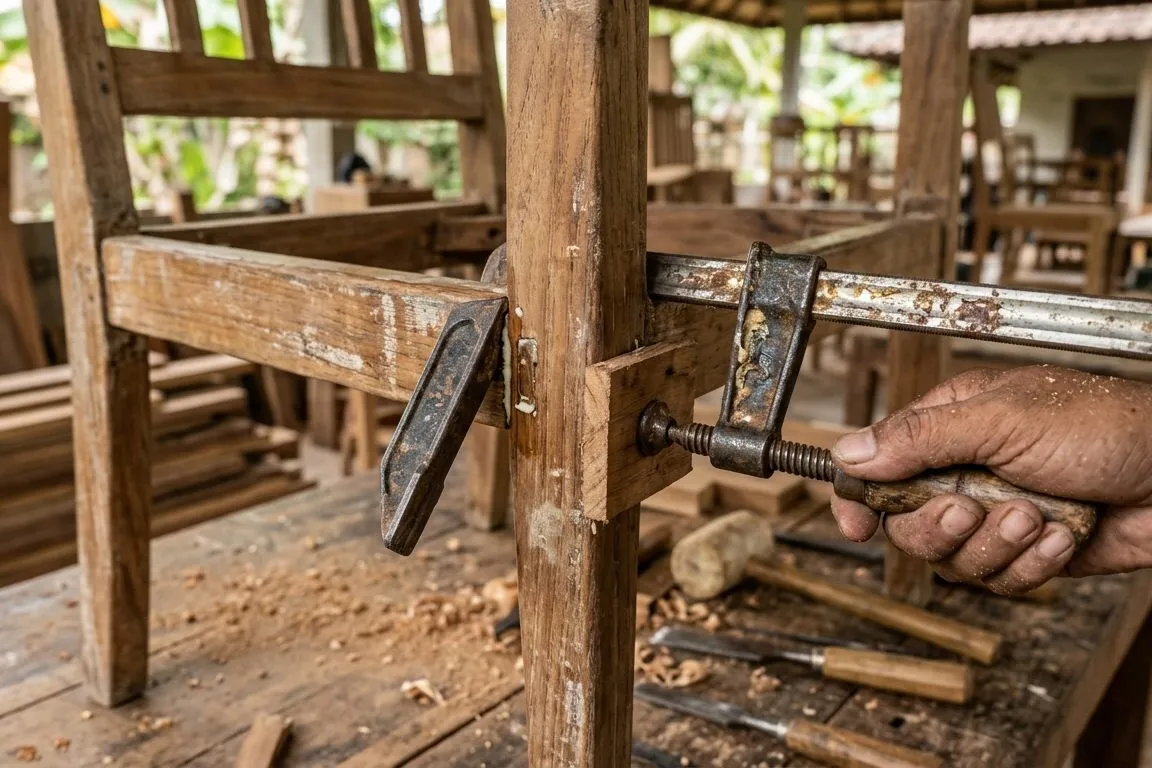
3. Structural repair. Loose joints are taken apart where possible, old glue cleaned out, and the joint re-glued and clamped. Cracks are stabilised. Missing parts are made in matching timber with the grain running the right way, so the new part moves with the old.
4. Surface repair. Dents are raised, small gaps filled, chips patched with timber rather than filler wherever the repair will show. On refinishing jobs, the old finish is removed and the surface prepared.
5. Finish matched to a sample. The new finish is tested on a sample before it goes on the piece. This is the same approach set out in our wood finishes guide: a physical sample on the actual species, approved by you before work goes ahead. On our standard finishes (natural oil, matte PU, white wash, antique) we can match closely. On an antique, the goal is usually to blend new work into the old surface rather than make it uniform.
Climate damage we see in Bali
Bali is hard on furniture. Most of what comes in for repair has been damaged by the climate rather than by accidents.
Humidity. Timber takes on moisture in the wet season and gives it up when the air dries or the air conditioning runs. That constant movement loosens joints, opens cracks in wide panels and makes drawers stick. Pieces moved between an air-conditioned bedroom and an open-sided living area suffer most.
Sun. Strong UV fades and dries finishes, bleaches timber and causes lacquer to crack and peel. One side of a cabinet near a window can end up a different colour from the other.
Outdoor greying. Teak left outside turns silver-grey as the surface weathers. This is cosmetic and the timber underneath is usually sound. A light sand and re-oil can bring back the colour if you prefer it. Our guides to outdoor teak furniture in Bali and teak care in a tropical climate explain how to slow this down once the piece is back.
Termites and wood-boring insects. Fine powder below a piece, small round exit holes or hollow-sounding timber are warning signs. Active infestations need treating before any repair, or the problem returns.
Upholstery, pickup and timing
Chairs, sofas and headboards often need upholstery as well as timber work. We work with fabric and leather on custom pieces.
For collection and return, ask us when you send photos. Our standard local deliveries are blanket-wrapped, and you can check the zones on our delivery and shipping page.
We confirm the timing in writing with the quote, before work starts.
How to send photos for a quote
A good set of photos lets us give you a realistic scope before the piece comes in. Send them on WhatsApp to +62 812-3842-178.
- The whole piece from the front, side and back, in daylight.
- Close-ups of every area of damage, with a coin or ruler in frame for scale.
- The underside and the inside of drawers or doors, where construction shows.
- Any labels, stamps or marks.
- Overall dimensions.
- What you want: repair only, a refresh of the existing finish, or a full refinish. For antiques, tell us whether you want to keep the old surface.
We reply within 48 hours. Some pieces need to be seen in person before we can give a firm price.
Frequently asked questions
Can you restore furniture you did not make?
Yes. We restore solid wood furniture and antiques whoever made them. What matters is the material: solid timber can be repaired and refinished, while HPL, MDF and vinyl surfaces cannot.
Will refinishing reduce the value of my antique?
It can. Stripping an antique removes the patina and wear that show its age, and collectors value those. For antiques we start with cleaning and conservation, and only refinish with your agreement.
Can teak that has turned grey be brought back?
Usually, yes. Greying is surface weathering, and the timber underneath is normally sound. A light sand and a fresh oil finish bring back the warm colour, though it will grey again outdoors unless it is maintained.
Can a restored piece match my other furniture?
We match finishes against a physical sample on the same species, and you approve it before we finish the piece. On old timber, the colour of the wood itself may differ slightly, so we aim for a close blend rather than an exact copy.
Bring us the piece, or the photos
Restoration is part of our services, carried out in the same Celuk workshop where we build new furniture. Send photos on WhatsApp to +62 812-3842-178 and we will come back within 48 hours with what we think the piece needs. If you are furnishing a whole property and want restored pieces alongside new ones, see how we work as a furniture supplier in Bali.