
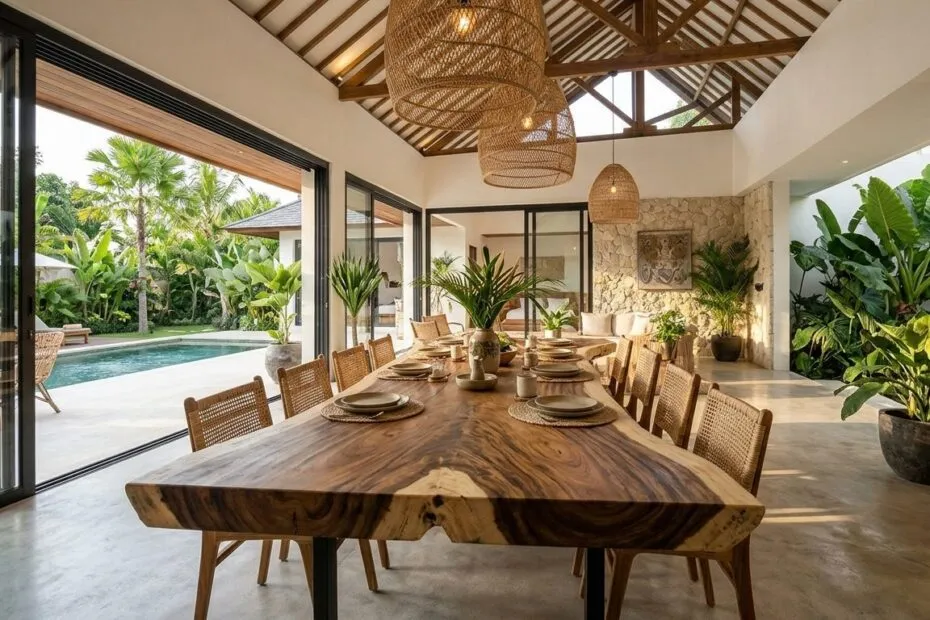
For most dining tables, the choice comes down to this. Teak if the table goes outdoors or must last with little care. Suar if you want a single dramatic slab with a live edge. Mahogany if you want a fine, even grain indoors at a lower price than teak.
All three are solid Indonesian hardwoods, and we make dining tables in all of them, plus reclaimed timber. The differences show up in how the table looks, how it handles daily wear, where it can live, and what it costs.
Below is a side-by-side comparison, then a closer look at each factor. For the full background on each species, see our guides to teak, suar and mahogany.
Side by side
| Teak | Suar | Mahogany | |
|---|---|---|---|
| Look | Golden to mid brown, straight grain, darkens with age | Wide figure with light and dark streaks, often with a live edge | Reddish brown, fine and even grain |
| Typical top | Jointed boards | Single slab or two book-matched slabs | Jointed boards |
| Stability | Very stable | Stable when properly dried; thick slabs need longer drying | Stable indoors |
| Daily wear | Natural oils help resist water and stains | Shows dents and rings more without a protective finish | Needs a good finish against water marks |
| Indoor or outdoor | Both | Indoor | Indoor |
| Suits | Natural oil, matte PU, white wash, antique | Natural oil or matte PU to show the grain | Matte PU, antique, stained finishes |
| Relative cost | Dearer than mahogany | Depends heavily on slab size | Lower than teak |
Look and grain
Teak has a warm golden-brown tone and a mostly straight grain. It darkens and mellows indoors. Outdoors, without maintenance, it weathers to silver grey. It reads as classic and calm, and suits both tropical and more formal rooms.
Suar is chosen for its figure. Wide boards show swirling grain and contrasting light and dark bands, and a live edge keeps the natural outline of the tree. A suar slab is the centre of the room. That is the appeal and also the limit: it is harder to pair with busy chairs or patterned floors.
Mahogany has a fine, even grain and a reddish-brown colour. It takes stain evenly, so it can be finished lighter or darker to match existing furniture. It suits traditional and colonial-style rooms well.
Slab tops and jointed tops
This is often the deciding factor.
A jointed top is made from several boards glued edge to edge. It is the normal way to build teak and mahogany tables, and it has practical advantages. Boards can be selected for colour, the top moves less as a whole, and almost any size is possible.
A slab top is cut from a single wide section of the trunk, or from two slabs joined down the middle. Suar is the classic slab timber because the trees grow wide. A slab gives an unbroken surface and a live edge, but it brings two risks. First, thick slabs take a long time to dry properly. Our suar guide notes the drying risk on slabs thicker than 7 cm: a slab that is not dry enough can crack or cup after delivery, especially when it moves into an air-conditioned room. Second, natural features such as end checks and small voids are part of the slab and may be stabilised and kept rather than removed.
When you buy a slab table, ask how the slab was dried and how long for.
Stability in a Bali home
Timber moves with humidity. A dining table in Bali may sit in an open-sided living area in the wet season and in an air-conditioned room the next year. All three timbers cope if they are properly dried before building, but they differ.
- Teak is the most forgiving. It moves little and its natural oils slow moisture exchange.
- Mahogany is stable indoors, but less tolerant of constant wetting and drying.
- Suar is stable once dry. The risk lies in thick slabs that were rushed.
Joinery matters as much as species. A top fixed rigidly to its base can split as it moves. Good construction lets the top move slightly across its width. Our post on working with a Bali furniture workshop covers what to check on drawings and during production.
Hardness and daily wear
None of the three is especially hard compared with dense tropical hardwoods. All will dent if you drop a cast-iron pan. In daily use, the finish does more to protect the top than the species.
That said, teak has an advantage. Its natural oils help it resist water and stains, so spills do less harm even on an oiled finish. Suar and mahogany show water rings and marks more readily unless they have a protective finish.
Indoor or outdoor
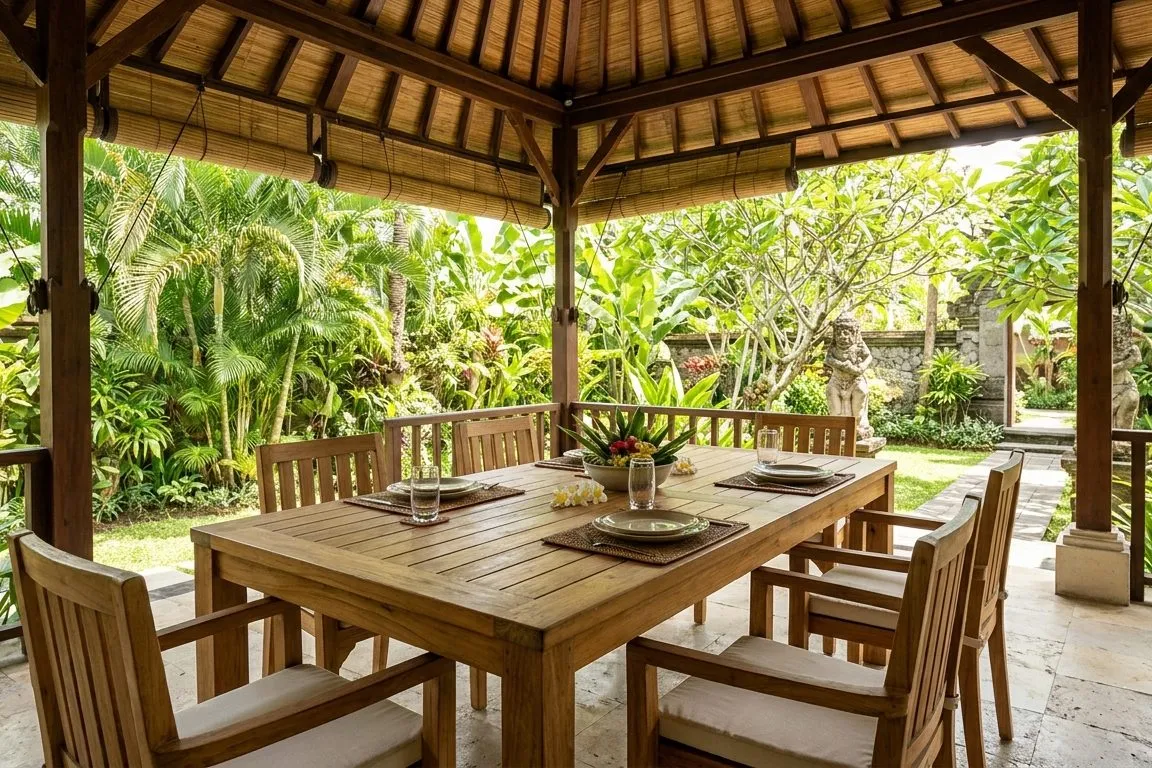
Of the three, teak is the one suited to outdoor dining. It handles sun and rain better than most timbers, and the worst that happens without care is greying. Our guide to outdoor teak furniture in Bali covers placement and maintenance.
Suar and mahogany belong indoors, or under a deep roof where they never get wet and are out of direct sun.
Finishes for a dining table
A dining table gets more spills, heat and cleaning than any other piece. Choose the finish with that in mind. Our wood finishes guide explains each in detail. In short:
- Natural oil looks and feels like wood and is easy to touch up, but needs re-oiling and is less resistant to water and heat. It suits teak best.
- Matte PU gives a protective film that handles spills and wiping better. It suits busy family tables, and suar and mahogany tops in particular.
- White wash softens the colour and suits teak or suar in light, coastal interiors.
- Antique gives a darker, aged look that suits mahogany and teak in traditional rooms.
We send a physical sample on the actual species before production, and keep the approved sample in the workshop for the life of the order.
Maintenance
- Teak, oiled: wipe clean, re-oil when the surface looks dry. Outdoors, decide whether you want to keep the colour or let it grey.
- Suar: use mats and coasters, wipe spills quickly, and keep it out of direct sun to limit fading.
- Mahogany: treat it like any fine indoor table. Coasters, no wet cloths left on the surface, and a gentle cleaner.
See how to care for teak furniture for more.
Relative cost
We do not publish dining table prices, because size, timber grade, finish and design move the figure a lot. In general terms, teak costs more than mahogany. Suar varies most: a modest slab can be good value, while a very wide single slab is rare and priced to match. Our post on what custom teak furniture costs in Bali explains what a quote should itemise.
Frequently asked questions
Which wood is best for a dining table in Bali?
For an outdoor or semi-outdoor table, teak. For an indoor statement table with a live edge, suar. For a fine-grained indoor table at a lower cost than teak, mahogany.
Will a suar slab table crack?
A well-dried slab should not, but thick slabs carry more risk if they were dried too quickly. Ask how the slab was dried, and avoid moving it straight from a humid space into strong air conditioning.
Is mahogany a good alternative to teak?
Indoors, yes. It has a fine grain, takes stain well and costs less. It is not a substitute for teak outdoors.
Can I get matching chairs?
Dining sets are available on request.
Ask for the dining sets catalogue
Our dining sets catalogue is available on request. Message us on WhatsApp at +62 812-3842-178 with your room size, number of seats and preferred timber, and we will reply within 48 hours. You can browse the rest of our catalogue in the meantime. For delivery within Bali, custom orders take 4 to 8 weeks, confirmed in writing with the quote.